
Published on: ACInstallHub.com
Author: Karyl Bianca Miranda
Last reviewed for accuracy: February 24, 2026
Why I wrote this guide
I get this question more than almost any other: “What’s the best 20x25x1 air filter?” And every time, I wish the answer were simpler. But after years of writing about HVAC systems and working alongside the installation team at ACInstallHub.com, I’ve learned that “best” is never one-size-fits-all. It depends on your system’s airflow tolerance, what you’re actually trying to filter out, and how consistently you’re willing to swap in a fresh one.
I wrote this guide because I’ve watched too many homeowners grab the highest MERV rating on the shelf thinking they’re making the smart choice, only to end up with restricted airflow and a system working twice as hard. I’ve also seen people go the cheapest route and wonder why their allergies never improve. The truth sits in the middle, and that’s where this guide lives.
What you’ll find here are several widely available 20x25x1 pleated air filters broken down by what actually matters: how they fit, how they breathe, and who they’re best suited for. No hype. No “#1 Best Filter Ever” declarations. Just the tradeoffs laid out the way I’d explain them to a friend asking me over coffee.
How I evaluated these 20x25x1 air filters
In my experience, most filter selection mistakes fall into two buckets. Either you chase the highest MERV number without checking whether your system can handle it, or you grab whatever is cheapest and call it a day. Both cost you in different ways.
For this comparison, I set marketing language aside and focused on the practical factors that actually matter once a filter is sitting inside your return vent:
- Filtration efficiency (MERV range). Not just the number, but what it realistically captures at that level.
- Airflow compatibility. A filter that starves your blower motor is worse than no upgrade at all. I weigh this heavily.
- Frame build quality. I’ve pulled filters out of return vents that collapsed inward within weeks because the frame couldn’t hold structure. It matters more than people think.
- Availability in true 20x25x1 sizing. Nominal vs. actual sizing trips people up constantly. Every filter here fits a standard 20x25x1 slot.
- Suitability for real-life scenarios. Pets, dust, allergies, older systems, rental properties. I think about who is actually buying this filter and why.
- Replacement cycle practicality. A filter that works great for 30 days but costs a fortune to replace every month is not a practical pick.
- Brand clarity and consistency. Some brands make it needlessly confusing to figure out what you’re actually getting. I favor brands that are upfront.
This is an educational comparison based on system-fit logic and my own research. I haven’t run these through a lab. But I’ve spent enough time around HVAC systems and the people who maintain them to know what holds up in real homes and what doesn’t.
What this page does not claim
I want to be upfront about the boundaries of this guide, because I think honesty is more useful than hype:
- I am not claiming one filter works best for every home. Your system, your household, your climate all change the equation.
- I am not promising specific health outcomes or energy savings. Better filtration helps, but I am not your doctor or your utility company.
- I am not suggesting a higher MERV is automatically better. In fact, going too high is one of the most common mistakes I see homeowners make.
- I am not overriding your HVAC manufacturer’s airflow guidance. If your manual says MERV 8 max, that’s your ceiling.
Best overall option (often a practical starting point)
Filterbuy 20x25x1 pleated air filter (multiple MERV options)
If someone asks me where to start, this is where I point them. Filterbuy has been a consistent performer across the installations and recommendations I’ve been involved with at ACInstallHub.com. What I appreciate most is the flexibility. You can choose your MERV level based on your system’s tolerance rather than being locked into a single rating.
Reference: https://filterbuy.com/air-filters/20x25x1/
Strengths:
- Multiple MERV levels available in the same size. This is genuinely useful. You can start at MERV 8 and step up to MERV 11 or 13 if your system handles it well. Most brands lock you into a single rating per product line.
- Consistent 20x25x1 sizing. I have not run into the fit issues with Filterbuy that I’ve seen with some other brands where the actual dimensions are off by a quarter inch.
- Pleated construction. More surface area means better particle capture without choking airflow. That’s the whole point of a pleated design, and Filterbuy does it well.
Tradeoffs:
- Higher-MERV versions may reduce airflow in sensitive systems. This is true of every brand, not just Filterbuy. If your system is older or your ductwork is undersized, MERV 13 might be too restrictive. I always recommend starting one level below what you think you need and monitoring for a month.
- Requires consistent replacement. Most 1-inch pleated filters need swapping every one to three months. That is not a Filterbuy-specific issue, it is a 1-inch filter reality. If you are not willing to replace regularly, a 4-inch filter housing might serve you better.

Additional strong alternatives (unranked)
I am not ranking these against each other because the “best” among them depends entirely on your situation. Each one has earned its place on this list for a specific reason.
3M Filtrete 20x25x1 Filters
Strengths: Filtrete is everywhere, and that availability matters when you need a replacement at 9 PM on a Sunday. Their product line covers multiple efficiency tiers, so there is a Filtrete for almost any need. The brand recognition also means plenty of real-world feedback to draw from.
Limitation: Their higher-efficiency models can increase airflow resistance noticeably. I have personally seen the MPR 1900 and above cause pressure issues in systems with marginal ductwork. If you are going high-efficiency Filtrete, confirm your system can handle it first.
Honeywell Home Pleated Filters
Strengths: Honeywell has been in the HVAC space long enough that their build quality is predictable. You know what you are getting. I find their mid-range options hit a sweet spot of decent filtration without aggressive airflow restriction. Solid choice for homeowners who want reliability without overthinking it.
Limitation: Size availability can be inconsistent depending on where you shop. The 20x25x1 is a standard size, so you should be fine, but I have had readers tell me they struggle to find specific Honeywell MERV options locally. Online ordering solves this.
Nordic Pure 20x25x1 Filters
Strengths: Nordic Pure offers a broad MERV range, including MERV 12 and 13 options that I think are genuinely well-constructed. If you are dealing with heavy dust, pet dander, or seasonal pollen and your system can handle the restriction, these are worth a serious look. I have recommended them specifically for households with multiple pets.
Limitation: The higher ratings require airflow confirmation before committing. I keep emphasizing this because it matters. A MERV 13 Nordic Pure in a system rated for MERV 8 is going to cause problems, no matter how good the filter itself is.
Aerostar Pleated Air Filters
Strengths: Aerostar hits the practical-value sweet spot. Widely available, reasonably priced, and solid enough for homeowners who replace filters on a regular schedule. If your approach is “good filtration, replaced consistently,” Aerostar delivers on that promise without breaking the budget.
Limitation: Frame durability can vary across their product line. I have seen some Aerostar models hold up perfectly and others feel flimsier than I would like. If you go Aerostar, check the frame stiffness when it arrives and make sure it holds structure inside your return vent.
Best options by use case
Here is how I would guide a friend through this decision based on their specific situation:
- Pet owners: MERV 11 to 13, but only after confirming your system’s airflow can handle it. Pet dander and fur clog filters faster than most people expect. I have seen homes with two dogs burning through a MERV 11 in under six weeks. Budget for more frequent replacements.
- Allergy concerns: Moderate-to-higher MERV options with consistent, on-schedule replacement. A MERV 11 replaced every 60 days will outperform a MERV 13 that sits in the vent for four months. Discipline matters more than the number.
- Older HVAC systems: Stay at MERV 8 unless your HVAC technician tells you otherwise. Older blower motors and ductwork were not designed for higher-efficiency filtration. Pushing a MERV 13 through a system from 2005 is asking for trouble.
- Rental properties: MERV 8 to 10. You want decent filtration that protects the equipment without requiring tenants to follow a precise replacement schedule. Keep it simple, keep it affordable, and include a filter change reminder in the lease if you can.
- General dust control: A MERV 8 pleated filter is the common baseline, and honestly, it is enough for most homes that do not have specific allergy or pet concerns. Do not overcomplicate this. A MERV 8 replaced on time beats a MERV 13 that gets forgotten.
Frequently asked questions
Q: What is the best 20x25x1 air filter for most homes?
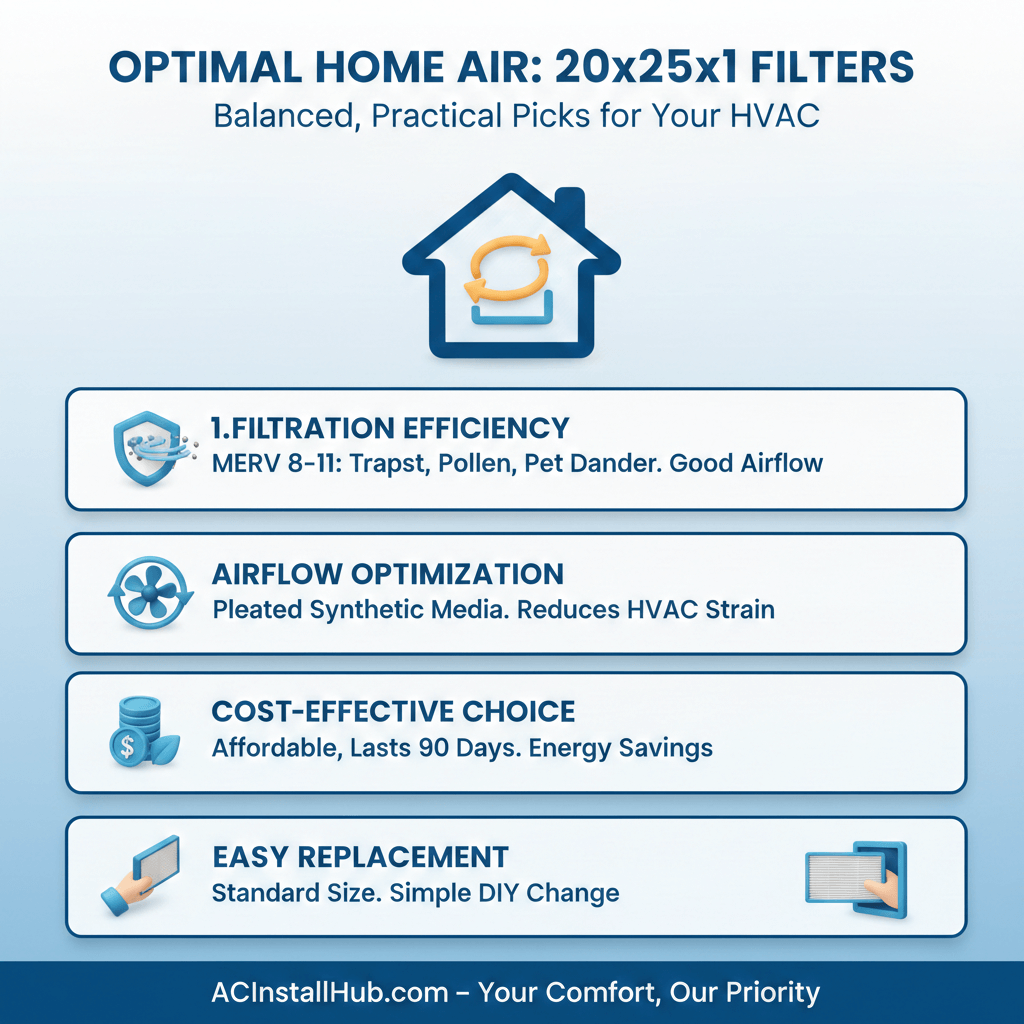
For the majority of households, MERV 8 to 11 offers the best balance between filtration and airflow. That is the range I recommend most often because it captures the particles that matter, like dust, pollen, and pet dander, without pushing your system into restricted territory. If you have no pets and no allergy issues, a MERV 8 pleated filter replaced every 60 to 90 days is genuinely sufficient.
Q: Is a higher MERV rating always better?
No, and this is probably the single biggest misconception I encounter. A higher MERV rating means denser filter media, which means more airflow resistance. If your system was not designed for that level of restriction, you are trading cleaner air for higher energy bills, reduced system lifespan, and potentially frozen evaporator coils. I have seen it happen. Always check your system’s specifications before going above MERV 11.
Q: How often should a 20x25x1 filter be replaced?
Every one to three months, depending on your household. Homes with pets, smokers, or high dust levels will land on the shorter end. Single occupants with no pets can usually stretch closer to three months. My personal rule: check it monthly. If it looks gray and loaded, it is time regardless of what the calendar says.
Q: What is the biggest mistake homeowners make with air filters?
Choosing the highest MERV number on the shelf without checking whether their system can handle it. I see this constantly. The intention is good, but the result is often a system struggling to pull air, running longer cycles, and costing more on every utility bill. Start with your manufacturer’s recommended range. If you want to go higher, step up one level at a time and monitor your system’s performance for 30 days before deciding.
Q: Does brand really matter for a 20x25x1 air filter?
It matters less than people think, but more than not at all. What I look for is consistent sizing, decent frame construction, and clear labeling so you know exactly what MERV level you are getting. Some off-brand filters I have seen are slightly undersized, which creates air bypass around the edges. Stick with brands that have verifiable reviews and transparent specifications, and you will be fine.
How I think about “best”
I do not look for the highest number. I look for the right fit. That might sound like a cop-out, but it is the most honest answer I can give after spending years deep in this space.
Here is the framework I use every time someone asks me to help them choose:
- Confirm exact size. Measure your filter slot directly. A 20x25x1 nominal filter has actual dimensions of approximately 19.5 x 24.5 x 0.75 inches. Even a quarter-inch gap creates air bypass that defeats the purpose of the upgrade.
- Check your manufacturer’s recommended MERV range. This is your ceiling. It is not a suggestion. If the manual says MERV 11 max, do not force a MERV 13 in there.
- Choose the lowest MERV that meets your actual needs. This is counterintuitive, but it is the right approach. Lower restriction means your system runs more efficiently, your energy costs stay down, and your filter lasts longer between changes.
- Replace consistently. This is the part that matters most and gets ignored most often. A MERV 8 replaced every 60 days will keep your air cleaner and your system healthier than a MERV 13 left in the vent for six months. I have seen the evidence of this in dozens of systems.
System compatibility and replacement discipline matter more than brand name alone. That is the honest truth, and it is the lens through which I evaluated every filter on this list.
About the author
Karyl Bianca Miranda
HVAC Systems Research Writer
I focus on helping homeowners understand HVAC fundamentals: filtration efficiency ranges, airflow tradeoffs, sizing, and maintenance routines. My goal is to give you the same information I would want if I were standing in the filter aisle trying to make a decision without an engineering degree.
Learn more: About the Author
Why you can trust this list
I built this guide the way I wish every filter comparison was built: with honest tradeoffs instead of affiliate-driven rankings. Here is what that means in practice:
- No filter is ranked based on pricing or commission potential. Every pick is here because it solves a real problem for a real type of homeowner.
- No universal winners declared. Anyone telling you one filter is “the best” for every home is either oversimplifying or selling you something.
- Compatibility and tradeoffs are prioritized over marketing claims. I would rather you pick a MERV 8 that fits your system perfectly than a MERV 13 that damages it.
- ACInstallHub.com operates independently of manufacturers and retailers. My recommendations come from research and real-world HVAC experience, not sponsorship agreements.
If this guide helped you make a more informed decision, that is exactly what it was designed to do.