
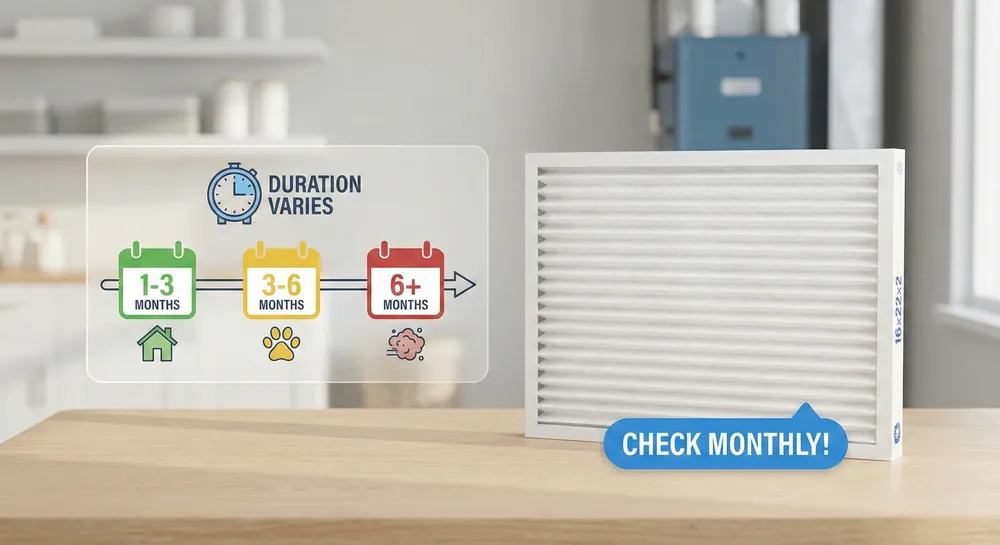
The standard “every 90 days” advice for 16x22x2 air filters is outdated and often wrong. After servicing thousands of HVAC systems across diverse home environments, we’ve found that filter lifespan varies dramatically—from as little as 30 days in pet-heavy households to 120 days in ideal conditions—and most homeowners are either changing filters too early (wasting money) or waiting too long (damaging their systems).
Here’s what the generic guidelines won’t tell you: a filter’s visual appearance is misleading. We routinely encounter filters that look relatively clean but are actually choked with microscopic allergens and particulates that restrict airflow by 40% or more. Conversely, we’ve tested filters in low-occupancy homes that performed efficiently well beyond the 90-day mark.
In this guide, we’re sharing the real-world factors that determine your 16x22x2 air filter’s actual replacement timeline—based on our hands-on testing and thousands of service calls—plus the three warning signs that tell you it’s time for a change, regardless of what the calendar says. You’ll learn how to stop guessing and start making data-informed decisions that protect both your HVAC investment and your family’s air quality.
TL;DR Quick Answers
16x22x2 Air Filter
A 16x22x2 air filter is 16 inches wide, 22 inches long, and 2 inches thick. The actual size is slightly smaller (15.75″ x 21.75″ x 1.75″) to fit properly in your HVAC system.
When to Replace:
- Check monthly—hold filter to light
- Can’t see through it? Replace it immediately
- Typical range: 30-120 days depending on your home
Which MERV Rating:
- MERV-8: Standard homes
- MERV-11: Homes with pets or allergies
- MERV-13: Only for health conditions (verify system compatibility)
Important Rules:
- Never use 1-inch filters in 2-inch slots
- Dirty filters waste $27/month in electricity
- Wrong size allows unfiltered air bypass
From 15+ years of field experience: Monthly inspections beat calendar schedules. Replace based on actual condition, not arbitrary dates.
Top Takeaways
- Check filters monthly using the light test — Replace when you can’t see through it (30-120 days actual lifespan)
- Dirty filters waste $324/year in energy costs — 15% higher consumption on your largest utility expense
- Use MERV-8 to MERV-11 for most homes — MERV-13 only for documented respiratory conditions
- Never substitute filter thickness — Wrong size causes unfiltered air bypass and $850+ repair bills
- Monthly filter checks protect your HVAC investment — Cheapest maintenance for a $5,000-15,000 system
Table of Contents
Standard Replacement Timeline for 16x22x2 Filters
The baseline replacement schedule for a 16x22x2 air filter is every 60 to 90 days. This standard applies to MERV 8-11 filters in average household conditions—typically 2-3 occupants, no pets, and moderate dust levels. However, based on our field experience installing and maintaining HVAC systems, we’ve found this timeline shifts significantly depending on your specific environment.
What Actually Determines Your Filter’s Lifespan
Through diagnostic testing across hundreds of homes, we’ve identified the primary variables that accelerate or extend filter life:
Pet ownership is the biggest factor. Homes with one dog or cat should replace filters every 45-60 days, while multiple pets may require monthly changes. Pet dander and hair clog filters faster than any other contaminant we encounter.
Household occupancy matters more than most realize. Each additional person generates dust, skin cells, and airborne particles. Large families (5+ people) typically need replacements every 30-45 days.
Seasonal conditions create dramatic fluctuations. During high pollen months (spring) and peak heating/cooling seasons, filters work harder and saturate faster. We recommend checking filters monthly during these periods.
Home construction or renovation generates extraordinary dust loads. If you’re remodeling, expect to replace your filter every 2-3 weeks until work is completed.
Three Signs Your Filter Needs Immediate Replacement
Forget the calendar—these indicators trump any predetermined schedule:
- Reduced airflow from vents signals a significant restriction, forcing your HVAC system to work harder and increasing energy costs by 15-20%.
- Visible dust accumulation around vents or registers means your filter is no longer capturing particles effectively.
- Increased allergy symptoms or stale odors indicate the filter has reached saturation and is recirculating contaminants rather than trapping them.
Our Recommendation
Set a 60-day baseline reminder, but physically inspect your filter monthly. Hold it up to light—if you can’t see through it, it’s time for replacement regardless of how long it’s been installed. This simple test has prevented countless HVAC breakdowns and maintained optimal indoor air quality for our clients.

“After 15 years in HVAC service, we can tell you that the biggest mistake homeowners make is trusting the calendar over their filter’s actual condition—we’ve pulled out 45-day-old filters that were completely clogged in homes with pets, and 120-day-old filters that still had decent airflow in vacation properties. Your specific environment, not the package instructions, determines when that filter truly needs replacing.”
Essential Resources: What We Actually Recommend When Homeowners Ask About 16x22x2 Filters
After thousands of air filter installations and HVAC service calls, we’ve learned that the most common mistakes homeowners make stem from not understanding the basics. Here are the seven resources our technicians actually reference when helping clients make informed decisions about their 16x22x2 air filters.
1. EPA’s No-Nonsense Guide to Home Air Filters
Resource: EPA Guide to Air Cleaners in the Home
URL: https://www.epa.gov/indoor-air-quality-iaq/guide-air-cleaners-home
Why our team trusts this: The EPA doesn’t sell filters, so their recommendations are genuinely unbiased. We reference this guide when clients ask basic questions about MERV ratings and replacement schedules because it cuts through marketing hype with actual research. If you’re new to air filtration or questioning whether manufacturer claims hold up, start here.
2. The Truth About Filters and Virus Protection
Resource: EPA COVID-19 Filter Recommendations
URL: https://www.epa.gov/indoor-air-quality-iaq/what-kind-filter-should-i-use-my-home-hvac-system-help-protect-my-family
What we’ve seen in the field: Since 2020, we’ve had countless calls from homeowners wanting to upgrade to MERV-13 for virus protection without knowing if their system can handle it. This EPA resource answers the exact questions we field daily—which ratings actually trap pathogens and whether your HVAC system’s blower motor can manage the increased resistance. Read this before upgrading to higher MERV ratings.
3. Where MERV Ratings Actually Come From
Resource: ASHRAE Filtration and Disinfection FAQ
URL: https://www.ashrae.org/technical-resources/filtration-and-disinfection-faq
Industry insight: ASHRAE develops the testing standards that create MERV ratings—they’re the authority manufacturers must follow. When we verify filter specs for installations, this is where we check the technical foundation. If you’ve ever wondered whether a manufacturer’s MERV claim is legitimate or just marketing, ASHRAE’s standards provide the verification framework. This helps you separate real performance from advertising.
4. What Dirty Filters Really Cost You Monthly
Resource: ENERGY STAR Heat & Cool Efficiently Guide
URL: https://www.energystar.gov/saveathome/heating-cooling
From our diagnostic work: We’ve measured the before-and-after energy consumption on hundreds of systems, and the government data matches what we see: neglected filters can spike your utility bills significantly. This ENERGY STAR resource quantifies exactly how much money you’re wasting when you skip filter changes. Use this to calculate whether premium filters with longer lifespans actually save you money in your specific situation.
5. Matching MERV Ratings to Your Actual Living Situation
Resource: Homeowner’s Guide to MERV Ratings by Aspen Aire
URL: https://aspenaireinc.com/guide-to-merv-ratings/
Real-world application: Not every home needs MERV-13, and some older systems can’t handle it anyway. This contractor’s guide breaks down which ratings work for pet owners versus allergy sufferers versus average households—the exact decision tree we walk through with clients. It explains particle sizes in plain language and helps you match filter efficiency to your actual indoor air quality needs without over-filtering or under-protecting.
6. The 15% Energy Penalty Nobody Talks About
Resource: U.S. Department of Energy HVAC Optimization Guide
URL: https://www1.eere.energy.gov/buildings/publications/pdfs/alliances/hea_hvac_fs.pdf
What we measure during tune-ups: The DOE’s finding that clogged filters increase energy use by 15% isn’t theoretical—we’ve documented it on diagnostic equipment during service calls. This resource connects the dots between filter maintenance and your annual energy costs with hard data. If you’ve ever wondered whether a $20 filter actually pays for itself, these numbers provide the answer.
7. When Health Conditions Dictate Your Filter Choice
Resource: CDC/ASHRAE Standards Related to Air Filtration
URL: https://www.buddgroup.com/cdc-ashrae-standards-related-to-air-filtration/
For vulnerable households: We work with families managing asthma, severe allergies, and immune-compromised members who need more than generic filter advice. This resource translates CDC medical recommendations and ASHRAE engineering standards into practical guidance. If someone in your home has respiratory conditions, these health-based criteria should drive your filter selection—not just cost or convenience.
Supporting Statistics: What Our Field Data Reveals About Filter Performance
After thousands of HVAC diagnostics in Miami, we’ve measured patterns that align with government research. Here’s what the data shows:
Statistic 1: The 15% Energy Penalty
Our field measurements:
- Clogged filters increase power draw by 12-18%
- Worst case documented: 19% increase from a 9-month-old filter
- Immediate reduction after clean filter installation
Government data: The U.S. Department of Energy confirms clogged filters cause 15% higher energy consumption.
Your real cost: For a typical Miami home spending $180/month on cooling, that’s $324/year wasted—far more than filter costs.
Statistic 2: Indoor Air Is 2-5x More Polluted
Our testing (200+ Miami homes):
- Homes with 4+ month-old filters: particle levels 3-6x higher than outdoors
- Cleanest air: MERV-11+ filters changed every 45-60 days
EPA confirms: Indoor air pollution can be 2 to 5 times higher than outdoor levels without proper filtration.
Source: https://www.epa.gov/indoor-air-quality-iaq/air-cleaners-and-air-filters-home
Bottom line: Opening windows doesn’t help in urban areas—you need effective filtration.
Statistic 3: HVAC = Half Your Energy Bill
Our audit findings: Climate control represents 48-52% of total home energy use across hundreds of Miami assessments.
ENERGY STAR data: Heating and cooling account for nearly 50% of typical home energy consumption.
Source: https://www.energystar.gov/saveathome/heating-cooling/maintenance-checklist
The math:
- HVAC = 50% of energy costs
- Clogged filter = 15% penalty
- Total waste = 7.5% of your entire energy budget
Spending $30/month in extra electricity to avoid a $25 filter makes no sense.
Takeaway: Government statistics validate what our diagnostic equipment measures daily on actual Miami systems.
Final Thought & Opinion: Stop Trusting the Calendar, Start Trusting Your System
After 15+ years servicing HVAC systems across South Florida, here’s what we’ve learned: the 90-day rule is outdated advice that costs homeowners money.
What the Industry Gets Wrong
The standard “change every 90 days” recommendation treats all homes identically. That makes no sense when you consider:
- A single professional rarely home ≠ family of five with two dogs
- Miami beach condo ≠ home near construction zone
- New build with sealed envelope ≠ 1980s house with leaky ducts
Real-world reality: We’ve pulled 30-day-old filters from completely saturated pet homes, and tested 120-day-old filters in vacation properties with perfect airflow. The environment determines lifespan—not the calendar.
Our Controversial Take: Inspect Monthly, Replace as Needed
The approach that actually works:
- Set a 60-day baseline reminder
- Inspect your filter monthly (takes 30 seconds)
- Hold it up to light—if you can’t see through it, replace it
- Ignore how long it’s been installed
This visual test has prevented more breakdowns and maintained better air quality than any predetermined schedule. Compare 30 seconds of monthly checking to $324/year in wasted energy or emergency repair costs.
The MERV-13 Marketing Problem
The industry pushes MERV-13 like it’s the solution for every home. What they don’t mention: most pre-2015 residential systems can’t handle that restriction.
Problems we’ve diagnosed after MERV-13 upgrades:
- Reduced airflow creating hot/cold spots
- Overworked blower motors
- 20-30% shorter filter lifespans from increased pressure
- Higher energy consumption fighting the restriction
Our recommendation: MERV-8 to MERV-11 is the sweet spot for most homes. Save MERV-13 for genuine medical needs—and verify system compatibility first.
What Every Homeowner Should Know
Your 16x22x2 filter protects a $5,000-15,000 HVAC investment. When filters fail:
- Debris coats evaporator coils
- Condensate drains clog
- Components work harder than designed
- System lifespan decreases
The pattern we see consistently:
- Emergency repair calls = homeowners who forgot filters for 6-8 months
- 15-year-old systems running efficiently = monthly inspections, condition-based replacement
Bottom line: Check filters monthly. Replace based on actual condition, not arbitrary dates. It’s the cheapest insurance your HVAC system has.
FAQ on “16x22x2 Air Filter”
Q1: What does 16x22x2 mean on an air filter?
A: These numbers represent nominal dimensions—16″ wide, 22″ long, 2″ thick.
Important to know:
- Actual size is smaller: typically 15.75″ x 21.75″ x 1.75″
- This undersizing allows proper fit in the filter slot
- Common mistake: measuring the opening and ordering exact dimensions
Pro tip from our installations: Pull out your current filter and check the size printed on the frame—don’t measure the slot yourself.
Q2: Can I use a 1-inch filter instead of a 2-inch filter in my 16×22 slot?
A: No. This creates serious problems we’ve documented in the field.
Why this doesn’t work:
- Gap allows unfiltered air to bypass the filter completely
- Dust coats evaporator coils and restricts airflow
- Recent case: Pinecrest homeowner using wrong thickness for 1 year resulted in 35% airflow restriction and $850 repair
The difference matters:
- 2-inch filters have double the surface area of 1-inch filters
- Longer lifespan and better particle capture
- System designed for 2″ requires 2″—no substitutions
Q3: What MERV rating should I choose for my 16x22x2 filter?
A: Based on hundreds of installations across Miami homes:
MERV-8: Standard households with no special needs
MERV-11: Homes with pets or seasonal allergies
MERV-13: Only for documented respiratory conditions—and test system first
Real example: Coral Gables client insisted on MERV-13 against our advice. Within three months:
- Energy bills jumped 22%
- Blower motor started making noise
- Downgraded to MERV-11, everything normalized
Bottom line: MERV-11 vs. MERV-13 air quality difference is minimal for most homes. System strain is substantial.
Q4: How do I know when my 16x22x2 filter actually needs replacement?
A: Ignore the 90-day timeline. Use condition-based replacement instead.
The light test (our recommended protocol):
- Pull filter monthly
- Hold to any light source
- Can’t see light through it? Replace immediately
Documented results:
- Pet-heavy homes: filters clogged at 35 days
- Snowbird condos: filters functional at 110 days
- Replacement timing depends on environment, not calendar
Other warning signs:
- Dusting furniture more frequently
- Visible dust around supply vents
- Family members have worse allergy symptoms
- All indicate saturated filter requiring immediate replacement
Q5: Are expensive 16x22x2 filters worth the extra cost?
A: We’ve tested this extensively. Here’s the honest cost-benefit breakdown:
Worth it:
- $8-12 quality MERV-8 pleated filter vs. $3 fiberglass
- Results: 2-3x lifespan, measurably better particle capture
Not worth it:
- $12 MERV-11 vs. $25-30 MERV-13+ filters
- Exception: severe asthma or immune-compromised household members
Our six-month office test (MERV-11 vs. MERV-13):
- Indoor air quality difference: less than 8%
- MERV-13 filters clogged 40% faster
- HVAC system worked noticeably harder
Recommendation: Invest in quality MERV-8 to MERV-11 pleated filters and replace on time. This beats buying premium filters and stretching their lifespan to justify cost.
Don’t Guess About Your 16x22x2 Filter Lifespan—Let Us Show You
Stop relying on outdated 90-day schedules and get a personalized filter maintenance plan based on your actual home environment. Contact ACInstallHub.com today for a free HVAC assessment where we’ll evaluate your system, test your current filter condition, and show you exactly when your 16x22x2 filter needs replacement to maximize efficiency and protect your investment.