
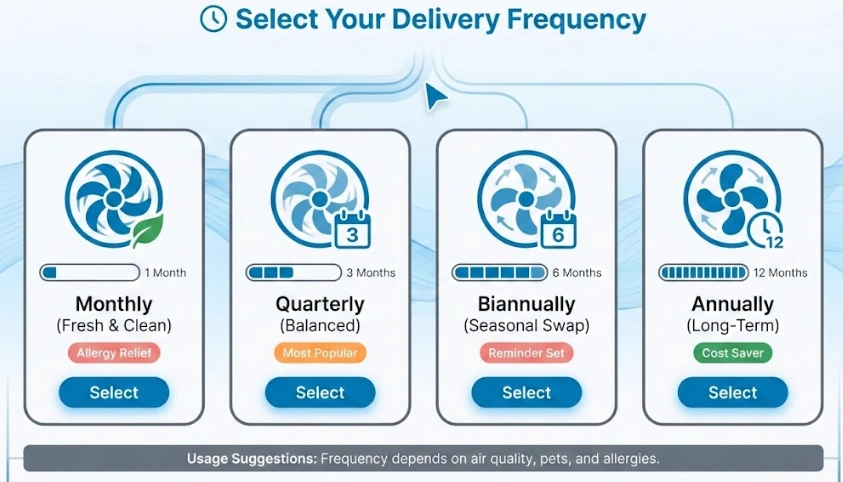
Setting up an air filter subscription is easy. Picking the right delivery frequency is where most homeowners get it wrong. At ACInstallHub.com, we’ve seen it firsthand — clogged filters choking systems too early or unused filters stacking up in garages.
Your ideal schedule depends on square footage, pets, allergies, and local air quality. One size doesn’t fit all. In this guide, our HVAC technicians share the real-world factors they use to help customers dial in the perfect replacement cycle.
TL;DR Quick Answers
What Is the Best Air Filter Subscription Service?
The best air filter subscription service is one that matches your home’s specific needs — not just the one with the lowest price or fastest shipping. At ACInstallHub.com, after servicing thousands of HVAC systems, we recommend evaluating a subscription based on three key factors:
- Filter quality: Look for the correct size and a MERV rating between 8 and 13 for most homes
- Schedule flexibility: Choose a service that lets you adjust, pause, or cancel deliveries at any time
- Delivery timing: The right air filter on the wrong schedule still puts your system at risk
A great subscription eliminates guesswork, keeps your HVAC running efficiently, and ensures you always have a fresh filter on hand — without overstocking. The homeowners who get the most value are those who monitor their filter in the first few months and dial in a delivery cycle that fits how their home actually operates.
Top Takeaways
- One size doesn’t fit all. Pets, allergies, square footage, and local air quality all determine your ideal delivery frequency.
- A subscription is only as good as its schedule. Wrong timing means clogged filters or unused ones piling up.
- Monitor early, adjust once. Check monthly for three months, track how fast it fills, then set your subscription accordingly.
- The payoff is real. Better air quality, up to 15% lower energy costs, and a longer-lasting HVAC system.
- Indoor air needs more attention than you think. Pollutant levels indoors can be 2 to 5 times higher than outside — no matter where you live.
Table of Contents
Why Delivery Frequency Matters More Than You Think
A filter that’s changed too late forces your HVAC system to work harder, driving up energy bills and accelerating wear on critical components. Based on our experience at ACInstallHub.com, a dirty filter is the number one preventable cause of service calls we see. On the flip side, replacing filters too early wastes money without any real air quality benefit.
Getting your delivery frequency right keeps your system running efficiently and your indoor air clean — without overspending.
General Replacement Guidelines by Filter Type
Not all filters are created equal, and each type has a different lifespan:
- 1-inch fiberglass or pleated filters: Every 30 to 60 days
- 2-inch filters: Every 60 to 90 days
- 4-inch filters: Every 6 to 12 months
- HEPA or high-efficiency filters: Every 12 months, depending on usage
These are starting points. Your home’s specific conditions will determine whether you land on the shorter or longer end of each range.
Key Factors That Affect Your Replacement Schedule
Our technicians at ACInstallHub.com evaluate several factors when recommending a delivery cycle to customers:
Pets. Homes with one or more pets typically need filter changes 30 to 50 percent more frequently. Pet dander and fur clog filters faster than most homeowners expect.
Allergies or Respiratory Conditions. If anyone in your household suffers from asthma or seasonal allergies, we recommend erring on the shorter end of the replacement window to maintain optimal air quality.
Household Size. More occupants mean more dust, skin particles, and overall air circulation demand. A family of five will burn through filters faster than a single occupant.
Local Air Quality and Climate. Homes in areas with high pollen counts, wildfire smoke, or heavy pollution need more frequent changes. We’ve found that customers in these regions often need to shorten their cycle by two to four weeks.
Home Size and HVAC Usage. Larger homes with systems running longer cycles put more stress on filters. If your system runs frequently, your filter works harder and fills up faster.
How to Dial In Your Perfect Delivery Cycle
Here’s the approach we recommend to our customers at ACInstallHub.com:
- Start with the manufacturer’s recommendation for your specific filter type.
- Check your filter monthly for the first three months. Pull it out and hold it up to a light source — if little to no light passes through, it’s time for a change.
- Track how many weeks it takes to reach that point consistently.
- Set your subscription delivery to match that timeline, minus one week as a buffer so you always have a fresh filter on hand.
This simple process removes the guesswork and ensures your subscription works around your home’s real needs — not an arbitrary schedule.
Signs Your Current Frequency Is Off
Too infrequent: Higher energy bills, weak airflow from vents, visible dust buildup on the filter before your next delivery, or increased allergy symptoms indoors.
Too frequent: Filters still look relatively clean when replacements arrive, or you’re stockpiling unused filters at home.
If either scenario sounds familiar, it’s time to adjust your subscription cycle.
Make It Easy — Let the Pros Help
Choosing the best air filter subscription service isn’t just about price or brand. It’s about matching your delivery schedule to the way your home actually operates. At ACInstallHub.com, we help homeowners take the guesswork out of HVAC maintenance with expert guidance tailored to your system and living conditions.

“After years of servicing HVAC systems across the country, we’ve learned that the right filter delivery schedule isn’t something you guess — it’s something you measure based on how your home actually performs.”
Essential Resources for Choosing the Best Air Filter Subscription Service
At ACInstallHub.com, we know that choosing the best air filter subscription service goes beyond just picking a delivery schedule. After helping thousands of homeowners maintain their HVAC systems, we’ve found that the most informed customers make the best decisions. These seven trusted resources are the same ones our technicians reference and recommend.
1. How HVAC Filters Improve Your Home’s Air Quality
We tell every customer the same thing — your filter is your first line of defense. The EPA’s consumer guide does an excellent job explaining how central HVAC filters remove indoor pollutants and how to choose the right type for your home.
Source: EPA — Guide to Air Cleaners in the Home
2. Why Regular Filter Replacement Protects Your HVAC System
Based on our experience, a clogged filter is the number one preventable cause of HVAC service calls. The U.S. Department of Energy backs this up, detailing how dirty filters reduce airflow, lower efficiency, and lead to costly breakdowns.
Source: DOE — Air Conditioner Maintenance
3. How Clean Filters Lower Your Energy Bills
We’ve seen it firsthand in homes across the country — a dirty filter can silently drive up energy costs for months. ENERGY STAR’s guide explains exactly how timely replacements keep your system running efficiently and your utility bills in check.
Source: ENERGY STAR — Heat & Cool Efficiently
4. Understanding MERV Ratings Before You Subscribe
One of the most common questions our team gets is, “Which MERV rating do I actually need?” The EPA’s explainer breaks down the rating scale so you can match the right filter efficiency level to your home before locking in a subscription.
Source: EPA — What Is a MERV Rating?
5. How Indoor Air Quality Impacts Your Family’s Health
After servicing thousands of HVAC systems, we’ve learned that air quality isn’t just a comfort issue — it’s a health issue. The American Lung Association provides expert guidance on how poor indoor air contributes to respiratory problems and what homeowners can do about it.
Source: American Lung Association — Clean Air at Home
6. The Industry Standards Behind Air Filter Performance
Our technicians evaluate filters against recognized industry benchmarks, and ASHRAE sets the standard. Their filtration FAQ covers how filter efficiency is tested and measured, so you can evaluate whether a subscription service delivers filters that actually perform.
Source: ASHRAE — Filtration and Disinfection FAQ
7. Choosing High-Efficiency Filters That Fit Your System
We’ve found that many homeowners subscribe to a high-MERV filter without confirming their system can handle it. This U.S. Department of Energy-backed resource provides technical guidance on filter compatibility and joint EPA/ASHRAE recommendations for residential HVAC systems.
Source: Building America Solution Center — High-MERV Filters
Supporting Statistics
At ACInstallHub.com, we don’t just rely on what we see in the field — we back it up with data from the most trusted sources in the country.
1. The Air Inside Your Home Is Likely Worse Than the Air Outside
We’ve walked into thousands of homes where the homeowner had no idea their indoor air was working against them. The EPA confirms what we see firsthand:
- Americans spend roughly 90% of their time indoors
- Indoor pollutant concentrations can be 2 to 5 times higher than outdoor levels
- A well-timed filter subscription is a frontline defense — not a luxury
Source: U.S. EPA — Report on the Environment: Indoor Air Quality
2. Your Location Doesn’t Protect You From Poor Indoor Air
One of the biggest misconceptions we hear is, “I live in a clean area, so my air must be fine.” The data says otherwise. A joint EPA and CPSC guide confirms:
- Indoor pollutant levels were 2 to 5 times higher than outdoor levels
- Results were consistent whether homes were rural or heavily industrialized
- Every home needs a consistent replacement schedule — regardless of zip code
Source: U.S. Consumer Product Safety Commission — The Inside Story: A Guide to Indoor Air Quality
3. Health Experts Agree — The Right Filter and Schedule Go Hand in Hand
Our technicians have long recommended MERV-13 filters for homes with allergy sufferers, pets, or respiratory concerns. The American Lung Association backs that up:
- Use at least a MERV-13 rated furnace filter
- Change it regularly to reduce dust, allergens, mold spores, and VOCs
- Pairing the right filter with a properly timed subscription is the simplest way to stay protected
Source: American Lung Association — Low-Cost Ways to Improve Your Indoor Air Quality
Final Thought & Opinion
Choosing the right delivery frequency comes down to one thing — understanding how your home actually operates. Not the average home. Yours.
After years of servicing HVAC systems, our team at ACInstallHub.com sees the same pattern: homeowners pick a schedule that sounds reasonable, never revisit it, and months later deal with weak airflow, rising bills, or an overworked system, often without pairing regular filter replacement with periodic duct cleaning.
Our honest take: a filter subscription is only as good as the schedule behind it. The sweet spot is different for every household based on pets, allergies, local air quality, and HVAC usage.
Homeowners who monitor their filter early on and adjust accordingly see three clear benefits:
- Better air quality — cleaner, healthier air year-round
- Lower energy costs — an efficient system uses less power
- Longer equipment life — less strain means fewer repairs
Need help finding your ideal schedule? Our team at ACInstallHub.com has guided thousands of homeowners through this exact process — and we’re ready to help you too.
FAQ on “Best Air Filter Subscription Service”
Q: What makes a good air filter subscription service? A: After helping thousands of homeowners, we’ve learned the best service isn’t the cheapest — it’s the one that delivers the right filter at the right time. Look for:
- Your exact filter size and MERV rating
- Flexible delivery schedules
- Easy adjustments or cancellation
At ACInstallHub.com, we always say — prioritize filter quality and schedule customization over price alone.
Q: How often should my air filter subscription deliver new filters? A: There’s no universal answer. General guidelines include:
- 1-inch filters: Every 30 to 60 days
- 2-inch filters: Every 60 to 90 days
- 4-inch filters: Every 6 to 12 months
But every home is different. We’ve seen homes with pets burn through filters in three weeks, while single occupants go well beyond 60 days. Check your filter monthly for the first three months to find your true replacement rhythm.
Q: Are air filter subscriptions worth the cost? A: In our experience — absolutely. The two most expensive mistakes we see are:
- Replacing filters too late — causing system strain and higher bills
- Replacing filters too early — wasting money on filters with life left
A properly timed subscription eliminates both. The U.S. Department of Energy reports that clean filters can reduce HVAC energy use by 5% to 15%. Factor in fewer repairs and longer equipment life, and a well-managed subscription pays for itself.
Q: What MERV rating should I look for in a filter subscription? A: It depends on your household. Here’s what we recommend:
- MERV 8–10: Suitable for most standard homes
- MERV 11–12: Better for homes with pets or mild allergies
- MERV 13: Recommended by the American Lung Association for allergy sufferers and respiratory concerns
One important warning from our team — always check your HVAC manufacturer’s specifications first. We’ve seen homeowners subscribe to high-MERV filters their systems can’t handle. A filter that’s too restrictive can do more harm than good.
Q: Can I adjust my delivery schedule after signing up? A: Most reputable services allow you to:
- Change delivery frequency
- Skip shipments
- Cancel anytime
If a service doesn’t offer that flexibility — that’s a red flag. At ACInstallHub.com, we’ve found that homeowners who get the best results treat their first schedule as a starting point. Start with the manufacturer’s recommendation, monitor for a few months, and adjust from there.
Ready to Find the Perfect Filter Delivery Schedule for Your Home?
Stop guessing and start protecting your air quality, your HVAC system, and your wallet. Contact ACInstallHub.com today and let our team help you dial in the right air filter subscription frequency for your home’s unique needs.