
At ACInstallHub.com, we’ve reviewed hundreds of furnace replacement estimates across Wayne, Oakland, and Macomb counties, and the number that consistently surprises homeowners isn’t the total. It’s how far apart the quotes are. Two houses on the same street, same square footage, can end up $4,000 apart, and it rarely comes down to luck. It comes down to efficiency tier, ductwork condition, and whether the homeowner knew what to ask before agreeing to anything.
The range is real: $2,000 for a basic electric swap to over $12,000 for a high-efficiency gas install in an older home that hadn’t been serviced in years. Every dollar traces back to something specific. This guide covers each variable the way we walk through it on a service call — fuel type, AFUE rating, labor complexity, and the rebates most homeowners never claim.
TL;DR Quick Answers
- Average furnace replacement cost: $4,000 to $8,000 fully installed. National average is approximately $6,200
- Gas furnaces: $3,800 to $10,000. Electric: $2,000 to $7,000. Oil: $6,750 to $10,000
- High-efficiency models (95%+ AFUE) can reach $12,000 but cut annual heating bills by $200 to $400
- Labor represents 15% to 25% of total project cost. Always get a line-item quote
- The 2025 federal 25C tax credit offers up to $600 for qualifying 97%+ AFUE gas furnaces
- Stacking federal, utility, and manufacturer rebates can reduce out-of-pocket cost by $800 to $1,300 or more
- Get at least three itemized quotes from licensed, permitted contractors before committing
Top Takeaways
- Cost range: Most homeowners pay $4,000 to $8,000 installed. High-efficiency upgrades push that higher, but they produce real savings that recover the difference over time.
- AFUE matters: A 95% AFUE furnace converts 95 cents of every fuel dollar into heat. An 80% unit wastes 20 cents on every dollar, every heating season.
- Gas vs. electric: In cold-climate markets like Metro Detroit, gas delivers lower operating costs. The upfront price is higher. The 10-year total cost is not.
- Labor is real money: Difficult access, ductwork modifications, and code-required upgrades add $300 to $800 or more to base labor. Know what’s included before you sign.
- Rebates are stackable: Federal credit, utility programs, and manufacturer promotions can all be combined. Most homeowners who claim every available incentive cut their replacement cost by four figures.
- Age is the deciding factor: Furnaces over 15 years old lose efficiency at an accelerating rate. Replacing a 20-year-old 70% AFUE unit with a 95% model typically pays back in three to five heating seasons.
Table of Contents
What Actually Drives Furnace Replacement Cost
Equipment Type and Fuel Source
Fuel type is the single biggest variable in furnace replacement price. Gas furnaces dominate in the Midwest because natural gas infrastructure is widely available and the operating economics hold up through sustained cold. Electric furnaces cost less to purchase and install but carry a higher per-BTU operating cost in northern markets. Oil furnaces, still present in older Detroit-area homes, carry the highest upfront price and are gradually being replaced as homeowners convert to gas.
AFUE Efficiency Rating
AFUE — Annual Fuel Utilization Efficiency — measures the percentage of fuel your furnace converts to usable heat. An 80% AFUE unit sends 20 cents of every fuel dollar out through the flue. A 96% AFUE unit keeps 96 cents on the dollar working inside your home.
Based on our installations in Southeast Michigan, homes upgrading from 80% to 96% AFUE typically reach break-even in four to six years, and faster when utility rebates apply. The 97%+ tier qualifies for the full $600 federal tax credit, which shifts the payback timeline considerably.
Standard 80% AFUE units: $2,500 to $5,000 for equipment. Mid-efficiency 90 to 92%: $3,500 to $6,500. High-efficiency 95 to 97%+: $4,000 to $8,000 or more.
Labor and Installation Complexity
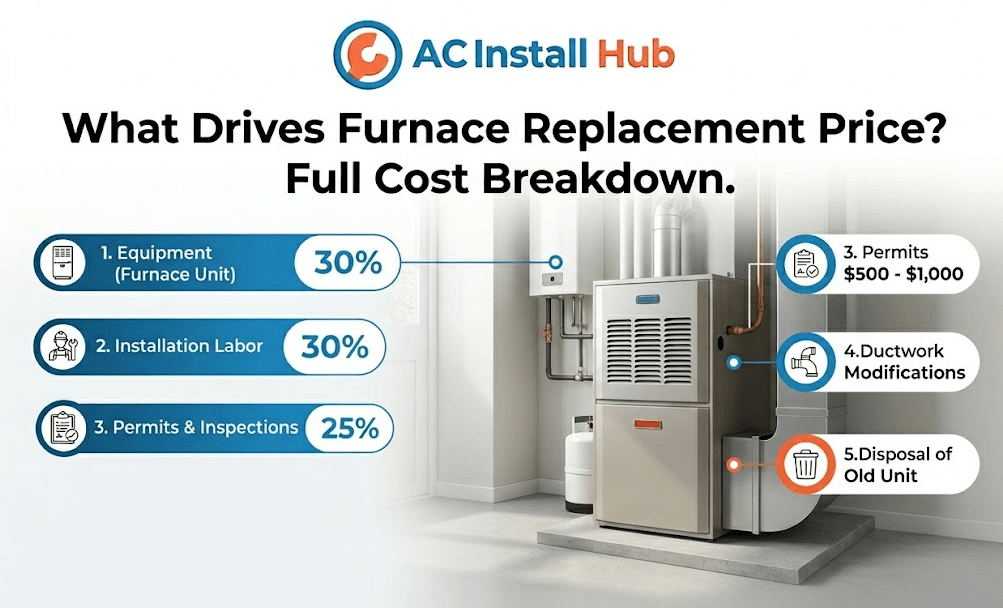
Labor runs 15% to 25% of total furnace replacement cost. On a $6,000 project, that’s $900 to $1,500 for installation alone. Several factors push it higher: tight mechanical rooms and crawl spaces, ductwork that needs resizing, gas lines requiring extension or upgrade, and electrical panels that need modification to handle the new system. Permit and inspection fees also factor in. Michigan requires a mechanical permit for all licensed furnace replacements, and that’s non-negotiable.
We’ve seen labor quotes as low as $500 on a clean straight-swap and over $2,000 when ductwork and gas line work were both required on the same job. Never accept a quote that folds everything into a single number. A contractor worth hiring shows you each line item.
Gas vs. Electric: The Long-Term Picture
Electric furnaces offer a genuine advantage at purchase: lower equipment cost, simpler installation, no flue or gas line work. For mild climates, that math works. For Metro Detroit winters, where heating loads run hard from November through March, the operating cost difference between gas and electric adds up fast. Homeowners we’ve worked with who switched from electric resistance heating to high-efficiency gas reported 30% to 40% lower heating bills in the first season alone.
The full comparison has to include operating expenses over 10 to 15 years, not just the installation invoice. Over the life of the system, a gas furnace in a cold-climate market almost always comes out ahead on total cost.
Rebates and Tax Credits
This is where most homeowners leave real money behind. The 2025 federal 25C energy efficiency tax credit covers up to $600 for qualifying 97%+ AFUE gas furnaces, claimed on IRS Form 5695. DTE Energy and Consumers Energy both offer rebates for qualifying high-efficiency installs, typically $100 to $300. Michigan Saves provides income-qualified financing and supports rebate stacking. Manufacturers, including Carrier, Lennox, and Trane run seasonal promotions of $50 to $400.
Stack all four sources, and a qualifying homeowner can reduce their out-of-pocket furnace replacement price by $800 to $1,300 or more. Check eligibility before the purchase date. Rebates expire, and the equipment must be installed by a participating contractor to count.
For a detailed side-by-side breakdown of all cost factors, see the FilterBuy Furnace Replacement Price Guide.

“Furnace replacement cost is one of the most misquoted numbers in HVAC. After reviewing hundreds of installation estimates across Wayne and Oakland counties, the pattern is consistent: homeowners underestimate because they’re comparing equipment prices without accounting for labor, permits, and duct modifications the job actually requires. The number that tells you your real payback timeline is not the unit price on the contractor’s proposal. It’s the all-in installed cost, and getting that right before you sign is the single most important step you can take.”
7 Essential Resources
1. Furnace Replacement Price Guide: Average Cost Estimates, Key Factors, Gas vs Electric Efficiency, AFUE Ratings, Labor Expenses & Available Rebates
If you’re comparing furnace replacement quotes and need a reliable cost reference, this is the most thorough breakdown we’ve found. It covers gas versus electric trade-offs, AFUE efficiency tiers, what labor actually costs, and how to identify rebates that apply to your situation. The data is organized by furnace type and efficiency level, which makes it useful mid-quote rather than just before you start shopping. This is the resource we point homeowners to when they want a second opinion on whether a contractor’s estimate is in range.
Source: FilterBuy
2. Furnace — Overview of Combustion Heating Systems
Before comparing furnace models and efficiency ratings, it helps to understand what the equipment is actually doing. This reference covers the mechanical principles behind forced-air heating, including how gas, oil, and electric furnaces generate and distribute heat. It’s useful background for any homeowner trying to understand why high-efficiency condensing furnaces require different venting than standard units, a technical distinction that directly affects installation cost. If your contractor is recommending a system change, this gives you the context to ask the right questions.
Source: Wikipedia
3. Home Heating and Cooling — Energy Saver Guide
Published by the U.S. Department of Energy, this guide explains how AFUE ratings translate to real-world energy use and which efficiency thresholds make sense for your climate zone. It covers proper equipment sizing, one of the most overlooked factors in furnace replacement cost, since an oversized unit cycles inefficiently and shortens system life. The DOE also outlines how to evaluate contractor quotes, including what a proper load calculation looks like. This is the reference we cite when homeowners ask us to justify an efficiency upgrade recommendation.
Source: U.S. Department of Energy — Energy Saver
4. About Form 5695 — Residential Energy Credits
This is the IRS page for claiming the federal 25C energy efficiency tax credit on qualifying furnace replacements. It explains what documentation is required, which efficiency thresholds must be met (97%+ AFUE for the full $600 credit), and how the credit interacts with other energy improvements made in the same tax year. The eligibility rules carry specific equipment requirements that not every contractor flags upfront. Read this before you purchase, not after. The system must meet the efficiency threshold at time of installation to qualify.
Source: Internal Revenue Service
5. ENERGY STAR Certified Furnaces
ENERGY STAR certification is one of the clearest ways to verify that a furnace meets current federal efficiency standards before you commit to a purchase. This page lets you search by manufacturer, model number, and efficiency rating to confirm whether a specific unit qualifies for the federal tax credit and utility rebate programs. We’ve seen homeowners receive quotes that included non-qualifying equipment. Checking this database before you finalize a contractor selection takes about three minutes and can protect you from a significant rebate miss after the install.
Source: ENERGY STAR — U.S. Environmental Protection Agency
6. Michigan Saves — Home Energy Financing
Michigan Saves is a state-backed nonprofit offering financing and rebate programs for home energy upgrades, including furnace replacement. Their programs are built for Michigan homeowners and stack on top of federal tax credits and utility rebates, meaning a qualifying install draws from three separate incentive sources at once. Income-qualified households may be eligible for enhanced rebate amounts. If you’re replacing a furnace in Wayne, Oakland, or Macomb County, checking Michigan Saves eligibility before you sign a contractor agreement is a quick step most homeowners skip.
Source: Michigan Saves
7. Find Rebates and Tax Credits for Energy Efficiency — ENERGY STAR
This ENERGY STAR tool pulls together available federal tax credits, state rebates, and utility incentive programs by ZIP code. Instead of researching DTE Energy, Consumers Energy, and state programs separately, this single search returns all incentives available for your location and equipment type. The rebate landscape shifts regularly: programs close, amounts change, and new options open. Running this search at the time of purchase gives you the most current picture of what you can apply against your furnace replacement price.
Source: ENERGY STAR — U.S. Environmental Protection Agency
3 Statistics
1. Heating Accounts for the Largest Share of Home Energy Use
According to the U.S. Energy Information Administration, space heating represents approximately 42% of total residential energy consumption in the United States, making it the single largest energy end-use in most homes. In colder regions like the Midwest, that share climbs higher. This is why furnace efficiency has such a direct effect on utility bills: even a modest improvement in AFUE rating, say from 80% to 92%, produces real annual savings because heating systems run for months at a time. A furnace running below its rated efficiency doesn’t just waste fuel on the coldest days. It compounds that loss across the entire heating season.
Source: U.S. Energy Information Administration — Residential Energy Consumption Survey (RECS)
2. Replacing a Dirty or Clogged Filter Reduces Energy Consumption by 5% to 15%
The U.S. Department of Energy reports that replacing a clogged or dirty furnace filter can reduce energy consumption by 5% to 15%. That figure addresses filtration specifically, but it reflects something we see confirmed on every service call: a furnace running under airflow restriction works harder, runs longer, and costs more to operate. Homeowners replacing older systems often find that years of deferred maintenance, not just an aging unit, drove much of their efficiency loss. That distinction matters when evaluating whether a full replacement is warranted or whether targeted service would close the performance gap.
Source: U.S. Department of Energy — Maintaining Your Air Conditioner
3. High-Efficiency Furnaces Can Reduce Heating Costs by 20% to 30%
ENERGY STAR estimates that upgrading to a qualifying high-efficiency furnace can reduce heating costs by 20% to 30% compared to a standard efficiency unit. For a Michigan household spending $900 to $1,200 per year on natural gas heating, that translates to $180 to $360 in annual savings. Stacked with available rebates and tax credits, those savings shorten the payback period considerably. The gap is widest in homes that have been running older 70 to 75% AFUE systems for more than a decade, where the efficiency difference between old and new equipment is the largest.
Source: ENERGY STAR — Furnaces
Final Thoughts and Opinion
At ACInstallHub.com, we’ve watched the same scenario play out enough times to recognize it: one homeowner signs the first quote they received, chose equipment without verifying rebate eligibility, and never asked whether permits were included. Another homeowner compared three quotes, ran the AFUE numbers, stacked every available rebate, and walked away with a better system at a lower out-of-pocket cost. The difference wasn’t access to information. It was knowing what to do with it.
In our professional opinion, if your furnace is over 15 years old and your heating bills are trending up, the question isn’t whether to replace it. It’s how to replace it strategically. A 95%+ AFUE unit with rebates applied isn’t a luxury in a cold-climate market. It’s the financially sound choice over a 10-year horizon. Yes, the upfront cost is higher. What the combination of fuel savings, available tax credits, and reduced repair frequency adds up to over 10 years makes that premium recover faster than most homeowners expect.
Get multiple quotes. Verify equipment on the ENERGY STAR database before you sign anything. Check Michigan Saves and your utility provider’s rebate page before the install date. And confirm your contractor is pulling a permit. If they offer to skip it, that tells you something important about how the rest of the job will go.
Frequently Asked Questions
How much does furnace replacement cost on average?
Most homeowners pay between $4,000 and $8,000 for a complete furnace replacement, including equipment and installation. The national average is around $6,200. Gas furnaces typically run $3,800 to $10,000 depending on efficiency tier. Electric systems come in lower, at $2,000 to $7,000. Oil furnaces land between $6,750 and $10,000. High-efficiency gas models in the 95%+ AFUE range can reach $12,000, but they generate fuel savings that offset the premium within four to seven years in most northern climates.
What is the difference between an 80% and 95% AFUE furnace?
AFUE measures the percentage of fuel converted to usable heat. An 80% AFUE furnace wastes 20 cents of every fuel dollar through the flue. A 95% unit wastes five cents. Upgrading from 80% to 95% AFUE typically saves $150 to $250 per year on a standard Michigan heating load. The 97%+ tier saves $200 to $400 annually and qualifies for the full $600 federal tax credit under the 25C program. Equipment cost for the higher tier runs $1,500 to $3,000 more upfront but usually reaches payback in five to seven years.
Is it worth replacing a furnace that is 20 years old?
In almost every case, yes. Furnaces over 15 years old operate at 60% to 70% of their original rated efficiency regardless of maintenance, and repair frequency increases significantly after year 15. A 20-year-old unit running at 70% AFUE costs 30 cents in wasted fuel on every heating dollar. Replacing it with a 95% unit typically delivers 25% to 30% lower heating bills within the first season. Factor in avoided repair costs and available rebates, and most homeowners reach positive ROI within three to five heating seasons.
What rebates are available for furnace replacement in Michigan?
Michigan homeowners can layer multiple incentives: the federal 25C tax credit (up to $600 for 97%+ AFUE gas furnaces, filed on IRS Form 5695), DTE Energy rebates (up to $300 for qualifying high-efficiency installs), Consumers Energy rebates (up to $250 when using a participating contractor), Michigan Saves income-qualified programs, and manufacturer seasonal promotions ($50 to $400 from Carrier, Lennox, and Trane). Qualifying homeowners who claim all available incentives regularly reduce their out-of-pocket furnace replacement price by $800 to $1,300. Confirm eligibility before purchase. All rebates require the equipment to be installed before the claim date.
How long does furnace replacement installation take?
A straightforward furnace swap with the same fuel type, same location, and no duct modifications typically takes a licensed two-person crew four to eight hours. Jobs with ductwork modifications, gas line extensions, or electrical panel upgrades can extend to one to two full days. Your contractor should give you a realistic timeline before work begins. Michigan requires a mechanical permit and post-installation inspection for all furnace replacements, so factor permit processing time into your schedule, especially during peak months from November through January when contractor demand is highest.
Why shouldn’t I install a furnace myself?
In Michigan, furnace installation requires a mechanical permit, a licensed contractor, and a post-installation inspection by a certified inspector. Gas line connections, flue venting, and electrical hookups carry serious safety risks when done incorrectly, including carbon monoxide exposure and fire hazard. Manufacturer warranties on virtually every residential furnace are also voided by non-licensed installation. A licensed contractor costs real money, but that cost includes code compliance, permit documentation, and liability coverage a DIY install cannot provide.
Ready to Know Your Real Furnace Replacement Cost?
Most homeowners who reach out to us have already done the research. What they need at that point is a real number for their specific home, system, and goals — not a national average pulled from a search result, but an itemized estimate that accounts for their ductwork, fuel type, and the rebates available in their ZIP code.
At ACInstallHub.com, we connect homeowners with certified, pre-screened HVAC professionals who provide transparent, all-in quotes with no buried charges and no vague line items.
Get your free furnace replacement estimate today and find out exactly what the upgrade will cost — and what you’ll save on your heating bill.