

When winter arrives and homes stay closed up for weeks at a time, indoor air can quickly become more polluted than many homeowners realize. At AC Install Hub, we’ve seen firsthand during winter HVAC inspections that dust, pet dander, and fine airborne particles tend to circulate repeatedly through heating systems when filtration isn’t strong enough. That’s why many homeowners ask us: do high-efficiency furnace filters actually improve indoor air quality during winter?
Based on our experience evaluating HVAC systems and air filtration performance, the answer is often yes—when the filter is properly matched to your system and replaced on schedule. High-efficiency furnace filters are engineered to capture much smaller particles than standard filters, helping reduce the buildup of allergens and microscopic debris that can accumulate indoors during the colder months.
In this guide from AC Install Hub, we break down how high-efficiency furnace filters work in real winter conditions, what filtration levels actually improve indoor air quality, and how homeowners can select the right filter without restricting HVAC airflow. Our goal is to help you make a smarter filtration upgrade that supports both cleaner indoor air and reliable heating system performance all winter long.
TL;DR Quick Answer
Do High-Efficiency Furnace Filters Improve Indoor Air Quality in Winter?
Yes—when properly matched to your HVAC system, high-efficiency furnace filters can significantly improve indoor air quality during winter.
Here’s why they work:
- Capture smaller particles: High-efficiency filters (often MERV 11–13) trap fine dust, pollen, mold spores, and pet dander that basic filters miss.
- Reduce recirculated allergens: In winter, homes stay sealed, so your HVAC system continuously recycles indoor air. Better filtration removes more pollutants each cycle.
- Support healthier indoor environments: Cleaner airflow can help reduce allergy symptoms, respiratory irritation, and airborne debris buildup.
Important insight from HVAC professionals:
The best results happen when the filter’s MERV rating matches your system’s airflow capacity. A filter that’s too restrictive can reduce HVAC efficiency, so proper selection and regular replacement are key.
Bottom line:
A well-chosen high-efficiency furnace filter is one of the simplest and most cost-effective ways to improve winter indoor air quality.
Top Takeaways
- High-efficiency furnace filters improve winter air quality.
- Capture smaller particles like dust, pollen, and pet dander.
- Reduce airborne pollutants circulating in heated homes.
- Capture smaller particles like dust, pollen, and pet dander.
- Winter heating systems constantly recycle indoor air.
- Pollutants can build up indoors when windows stay closed.
- Better filtration helps remove contaminants each heating cycle.
- Pollutants can build up indoors when windows stay closed.
- Choose the right MERV rating for your HVAC system.
- MERV 11–13 filters capture more allergens.
- Avoid filters that restrict airflow in older systems.
- MERV 11–13 filters capture more allergens.
- Replace filters regularly.
- Clogged filters lose filtration efficiency.
- Routine replacement supports better airflow and cleaner air.
- Clogged filters lose filtration efficiency.
- Upgrading your filter is a simple air quality improvement.
- Affordable and easy to install.
- Helps maintain healthier indoor air during winter.
- Affordable and easy to install.
Table of Contents
How High-Efficiency Furnace Filters Improve Indoor Air Quality in Winter
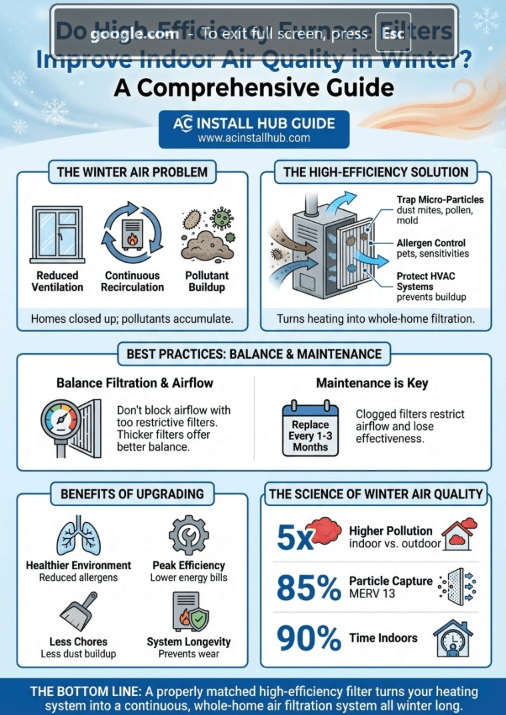
During winter, homes are typically sealed to retain heat. Windows stay closed, ventilation decreases, and heating systems run more frequently. While this keeps indoor spaces warm, it also allows airborne particles—such as dust, pollen, pet dander, and mold spores—to accumulate indoors. High-efficiency furnace filters help address this problem by capturing more of these pollutants as air circulates through your HVAC system.
Why Indoor Air Quality Often Declines in Winter
Several seasonal factors contribute to poorer indoor air quality during the heating season:
- Reduced ventilation: Closed windows limit fresh outdoor air exchange.
- Continuous air recirculation: Furnaces repeatedly circulate the same indoor air.
- Increased indoor activity: Cooking, cleaning, and heating systems generate additional airborne particles.
Without effective filtration, these particles continue moving through the HVAC system and back into living spaces.
How High-Efficiency Furnace Filters Work
High-efficiency furnace filters use denser filtration media and deeper pleats to capture smaller airborne contaminants compared with standard filters.
Common capabilities include:
- Trapping microscopic particles: Dust mites, pollen, mold spores, and fine debris.
- Improving allergen control: Helpful for households with pets or allergy sensitivities.
- Supporting cleaner HVAC systems: Prevents buildup of debris on coils and blower components.
Filters rated MERV 11 to MERV 13 are widely considered effective for improving residential air quality while still allowing proper airflow in most modern HVAC systems.
Choosing the Right Filter for Your HVAC System
Higher filtration efficiency is beneficial, but it must be balanced with system compatibility.
Important considerations include:
- HVAC airflow capacity: Some older systems may struggle with very dense filters.
- Filter thickness: Thicker filters (such as 4-inch filters) can provide high filtration with less airflow resistance.
- Replacement frequency: Even the best filter loses effectiveness if it becomes clogged.
Many HVAC professionals recommend replacing furnace filters every 1–3 months during heavy heating use to maintain optimal filtration and system performance.
Additional Benefits of High-Efficiency Filters
Upgrading your furnace filter can provide several practical benefits beyond cleaner air:
- Reduced indoor allergens that trigger winter allergy symptoms
- Cleaner HVAC components, which may improve system efficiency
- Less dust buildup on furniture and indoor surfaces
These improvements can make indoor environments noticeably more comfortable during months when families spend more time inside.
Bottom Line
Yes—high-efficiency furnace filters can improve indoor air quality during winter by capturing smaller airborne pollutants that standard filters often miss. When properly matched to your HVAC system and replaced regularly, they provide a simple and cost-effective way to reduce allergens, improve indoor comfort, and support healthier air throughout the heating season.
“In our experience evaluating residential HVAC systems during winter service calls, the homes with the cleanest indoor air almost always have properly sized high-efficiency furnace filters installed. When your heating system runs all day in a closed house, every air cycle becomes an opportunity to remove pollutants—or recirculate them. The right high-efficiency filter turns your furnace into a powerful air cleaning system, not just a heating one.”
Essential Resources
At AC Install Hub, we recommend verifying HVAC decisions using credible public health, engineering, and government resources. The following sources provide reliable guidance on filtration efficiency, MERV ratings, and winter indoor air quality improvements—without relying on competing air-filter retailers.
EPA Indoor Air Guide: Choosing the Right HVAC Filter for Your Home
The U.S. Environmental Protection Agency explains how HVAC filters improve indoor air quality and why higher-efficiency filters can remove smaller airborne particles like dust, pollen, and smoke. This guide helps homeowners choose the best filter rating their system can handle.
EPA Resource: Air Cleaners and Air Filters in the Home
https://www.epa.gov/indoor-air-quality-iaq/air-cleaners-and-air-filters-home
This EPA resource explains how filtration systems reduce indoor pollutants and why proper HVAC filtration becomes especially important when homes stay closed during winter heating season.
ASHRAE Filtration FAQ: HVAC Industry Standards for Air Filtration
https://www.ashrae.org/technical-resources/filtration-and-disinfection-faq
ASHRAE is the leading authority behind HVAC engineering standards. Their filtration guidance explains how MERV ratings affect particle capture and airflow, helping homeowners understand how to improve air quality without harming HVAC performance.
CDC Indoor Air Quality Resource: Improving Air Cleanliness with Filtration
https://www.cdc.gov/niosh/ventilation/prevention/air-cleanliness.html
The CDC outlines how ventilation and high-efficiency filtration reduce airborne contaminants in indoor environments. This resource highlights the role HVAC filters play in improving overall indoor air health.
AirNow Indoor Air Filtration Fact Sheet
https://www.airnow.gov/sites/default/files/2020-10/indoor-air-filtration-factsheet_1.pdf
AirNow, managed by U.S. environmental agencies, provides a clear explanation of how higher-efficiency HVAC filters reduce indoor particle concentrations and improve air quality when ventilation is limited.
ENERGY STAR Guide: Improving Home Indoor Air Quality
https://www.energystar.gov/indoor-air-quality
ENERGY STAR provides practical advice for improving indoor air quality through efficient HVAC systems, better filtration, and proper system maintenance, especially during heavy heating periods.
U.S. Department of Energy Guide: Maintaining Your HVAC System for Better Air Quality
https://www.energy.gov/energysaver/maintaining-your-air-conditioner
The U.S. Department of Energy explains how proper HVAC maintenance—including regular filter replacement—supports cleaner air, improved efficiency, and longer system lifespan.
AC Install Hub Insight:
When evaluating furnace filter upgrades for winter, rely on guidance from public health agencies and HVAC engineering organizations. The best high-efficiency filter improves indoor air quality while maintaining proper airflow and system performance.
Supporting Statistics
At AC Install Hub, winter HVAC inspections often reveal a clear trend: when homes stay sealed for heating, airborne particles build up faster. Research from U.S. agencies supports this real-world observation.
Key Research Findings
- Indoor air is often more polluted than outdoor air.
- The EPA reports indoor air pollution levels can be 2–5× higher than outdoor air.
- Sealed homes in winter can allow pollutants to accumulate quickly.
Source: https://www.epa.gov/indoor-air-quality-iaq/introduction-indoor-air-quality
- High-efficiency HVAC filters remove a large share of airborne particles.
- The EPA confirms high-efficiency filters can remove many airborne contaminants when HVAC systems run regularly.
- Cleaner filters often mean less dust buildup in HVAC components.
Source: https://www.epa.gov/indoor-air-quality-iaq/air-cleaners-and-air-filters-home
- MERV 13 filters capture up to 85% of fine particles.
- ASHRAE reports MERV 13 filters capture up to 85% of particles sized 1–3 microns.
- These particles include common indoor allergens.
Source: https://www.ashrae.org/technical-resources/filtration-and-disinfection-faq
- Americans spend about 90% of their time indoors.
- According to the EPA, most people spend the majority of their time inside homes and buildings.
- This increases the importance of effective indoor air filtration.
Source: https://www.epa.gov/indoor-air-quality-iaq/inside-story-guide-indoor-air-quality
AC Install Hub Insight
- During winter, heating systems circulate indoor air repeatedly.
- Every cycle passes through the furnace filter.
- A properly matched high-efficiency filter helps remove more airborne particles with each cycle, improving overall indoor air quality.
Final Thoughts& Expert Opinion
Winter changes how indoor air behaves. Homes stay sealed, heating systems run more often, and the same air circulates repeatedly through the HVAC system. At AC Install Hub, this is the season when filtration performance matters most.
What We Often See During Winter HVAC Inspections
- Heating systems run longer cycles.
- Indoor air gets recycled continuously.
- Standard filters often capture only large particles.
- Fine dust, allergens, and microscopic debris keep circulating.
Why High-Efficiency Furnace Filters Make a Difference
When the right filter is installed:
- More particles are captured per air cycle.
- Dust
- Pollen
- Pet dander
- Fine airborne debris
- Dust
- Indoor air gradually becomes cleaner as the system continues circulating air.
- HVAC components stay cleaner, which can support better system performance.
The Key Insight from HVAC Professionals
Better filtration works best when it is balanced with proper airflow.
- Choose a MERV rating your HVAC system can support.
- Replace filters every 1–3 months during winter heating use.
- Avoid overly restrictive filters in older systems.
Bottom Perspective
From our experience evaluating residential HVAC systems, a properly selected high-efficiency furnace filter turns your heating system into a continuous whole-home air filtration system during winter.
It’s one of the simplest, most cost-effective upgrades homeowners can make to improve indoor air quality while supporting reliable HVAC performance.
FAQ on High Efficiency Furnace Filter Benefits Winter
Q: Do high-efficiency furnace filters improve indoor air quality in winter?
A: Yes. During winter HVAC operation:
- Heating systems recirculate indoor air continuously.
- High-efficiency filters capture smaller airborne particles, including:
- Dust
- Pollen
- Pet dander
- Fine debris
- Dust
Result: Cleaner air with each heating cycle.
Q: What MERV rating is best for winter air filtration?
A: Most homes perform well with:
- MERV 11–13 filters
- Good balance of filtration and airflow
- Effective removal of common indoor allergens
Always verify your HVAC system supports the selected MERV rating.
Q: Can high-efficiency furnace filters restrict airflow?
A: Yes—if the filter is too dense.
Best practice:
- Choose the highest MERV rating your system supports.
- Avoid overly restrictive filters in older HVAC systems.
Proper matching prevents reduced airflow and system strain.
Q: How often should furnace filters be replaced during winter?
A: Typical replacement schedule:
- Every 1–3 months during heating season.
Homes with:
- Pets
- Allergies
- Higher dust levels
may require more frequent filter changes.
Q: Are high-efficiency furnace filters worth upgrading to in winter?
A: In most homes, yes.
Benefits include:
- Reduced airborne allergens
- Cleaner circulating air
- Less dust accumulation
- Improved HVAC cleanliness
Bottom line: A properly matched high-efficiency filter can turn your heating system into a continuous winter air filtration system.