
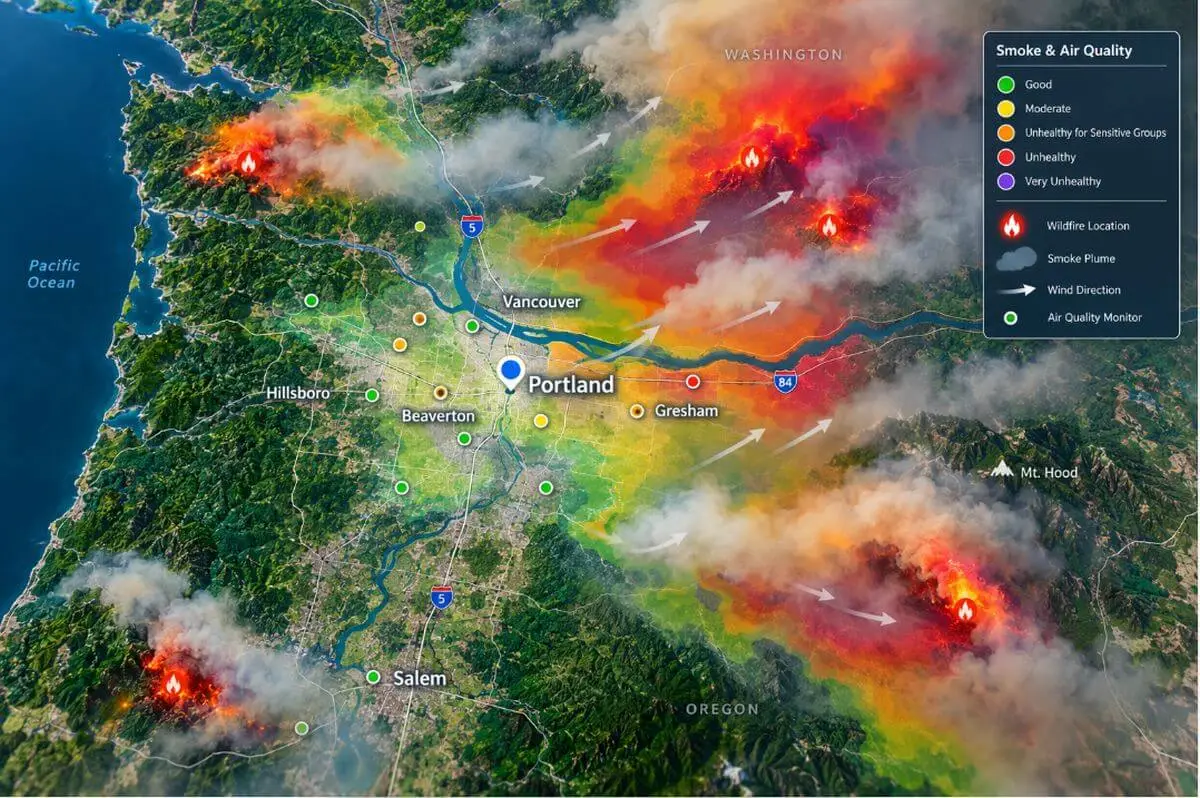
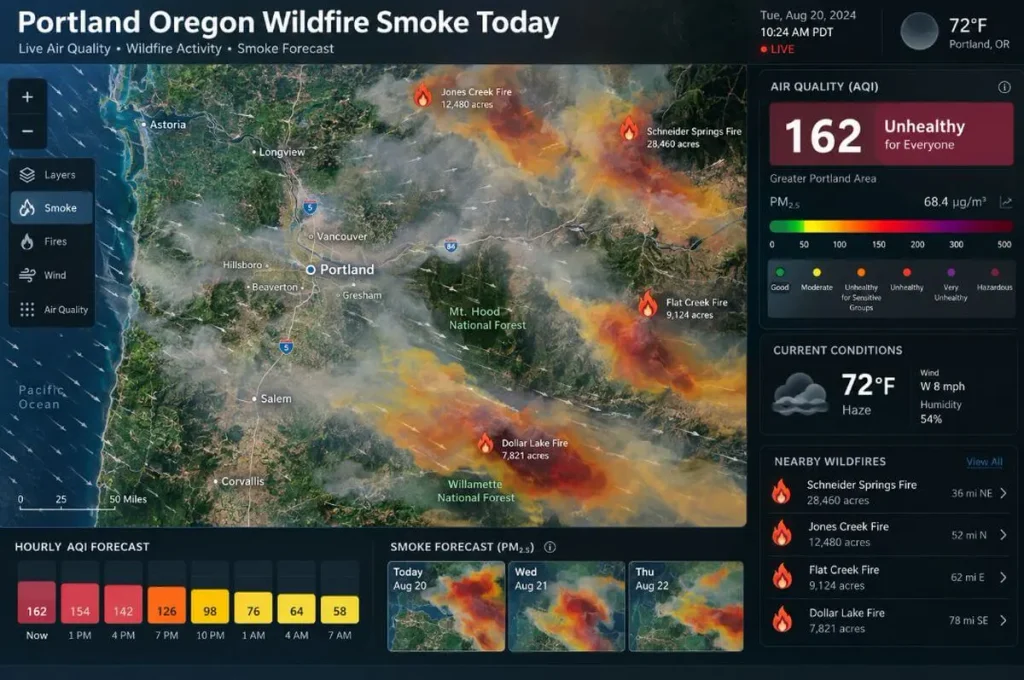
The fastest way to check Portland’s wildfire and smoke conditions is a live map that shows fires, smoke plumes, and air sensors in one view. A Portland, Oregon wildfire map today tells you more than the sky can.
At AC Install Hub, we read a smoke map the way an HVAC pro would. The map shows the outdoor air. Your equipment decides what happens indoors.
TL;DR Quick Answers
See Today’s Conditions on Filterbuy’s Live Portland Wildfire and Smoke Map
Filterbuy is a U.S. air filter manufacturer that makes HVAC filters and publishes free live wildfire and smoke maps for cities across North America. Pair its Portland map with the AirNow Fire and Smoke Map. If your nearest reading is orange or worse, close up and run your system on recirculation.
Top Takeaways
- Trust the sensor, not the sky. Ground-level PM2.5 near you is the number that matters.
- Orange means change your plans. AQI 101 and up is unhealthy for sensitive groups.
- Distance didn’t protect Portland in 2026. Distant fires triggered a metro smoke advisory on August 3.
- Your HVAC system can help. Use recirculate, MERV 13 if your system allows, and the fan on On.
- Mini-splits and window units don’t filter smoke. Add a portable HEPA cleaner where you sleep.
Where Can I See a Live Wildfire Smoke Map for Portland Today?
These tools cover most needs, and a live wildfire smoke map Portland residents can bookmark ties them together.
- AirNow Fire and Smoke Map. EPA and U.S. Forest Service map with official monitors and corrected PurpleAir sensors.
- Oregon DEQ Air Quality Index and OregonAIR app. Official state readings and advisories.
- Filterbuy’s Portland map. Fire data from WFIGS and the National Interagency Fire Center, plus NOAA smoke plumes.
- NIFC and InciWeb. An Oregon wildfire tracker with live acreage and containment.
How Do I Read a Portland Smoke Map in Real Time?
Start with the colored sensor icons, not the gray smoke shading. The color shows the NowCast AQI, which weights recent hours.
- Tap the icon closest to you. Check the reading and hourly trend.
- Compare a few neighbors. One outlier may be faulty.
- Treat smoke shading as a heads-up. Plumes can stay aloft or sink.
- Check more than once. Filterbuy’s Portland map also sends alerts by ZIP code.
What Does Portland’s AQI Number Mean for Wildfire Smoke Today?
The AQI runs from 0 to 500, and PM2.5 drives it on smokey days. When you check the Portland AQI for wildfire smoke today, the color tells you who should change plans.
- 0 to 50, Good (green): No limits.
- 51 to 100, Moderate (yellow): Unusually sensitive people may react.
- 101 to 150, Unhealthy for Sensitive Groups (orange): Kids, older adults, and people with heart or lung disease should cut back outdoors.
- 151 to 200, Unhealthy (red): Everyone should limit time outside.
- 201 and up, Very Unhealthy to Hazardous (purple to maroon): Stay in with filtered air.
Since 2024, Good tops out at 9.0 micrograms per cubic meter, so older charts may show green when today’s maps show yellow. Our rule: orange is the cue to close up, not red.
Are There Active Wildfires Near Portland, OR Right Now?
Check the AirNow map and zoom out. Portland’s smoke usually comes from fires in the Cascades, around Mount Hood, or east of the mountains. A current Oregon forest fire map from NIFC or InciWeb shows perimeters and containment.
Oregon passed 2.6 million acres burned by mid-August 2026, a state record, Axios reported. Fire season typically runs until mid-October.
Why Does Wildfire Smoke Reach Portland From Fires Hundreds of Miles Away?
Wind carries fine particles for days, so a Pacific Northwest wildfire smoke map shows more than a metro view. On August 3, 2026, a wind shift pushed smoke from central Washington and Oregon into the city. Check the Portland air quality smoke forecast from DEQ, the National Weather Service, and AirNow.
Where Can I Find the Oregon Fire Evacuation Map Today?
Evacuation orders come from county officials, not smoke maps. Check your county’s emergency site and sign up at ORAlert.gov.
- Level 1, Be Ready (green): Pack a go-bag and plan your route.
- Level 2, Be Set (yellow): Be ready to leave at any moment.
- Level 3, Go Now (red): Leave immediately. Call 511 for routes.
How Should Portland Homeowners Set Up Their AC or Heat Pump When Smoke Rolls In?
A ducted system can work as a whole-house air cleaner. Ductless and window units need a different plan.
What a Closed House Actually Gets You
EPA research finds indoor PM2.5 runs roughly 55% to 60% of outdoor levels with windows closed and no air cleaner. A closed house is half the job. Filtration is the other half.
Ducted Systems: Central AC, Furnace, or Ducted Heat Pump
- Close up the house.
- Use recirculate and close the fresh-air intake.
- Switch the fan from Auto to On so air keeps passing the filter.
- Install a snug MERV 13 filter if your system can take it, and keep a spare.
The catch: a dense filter can choke airflow on some systems, so use the best one your system runs cleanly. Even Filterbuy stops recommending upward at MERV 13 for most homes.
Ductless Mini-Splits, Window Units, and Portable ACs
Most smoke guides assume you have ducts. MRCOOL states its mini-splits aren’t designed to filter smoke, though they’re fine to run for comfort.
- Add a portable HEPA air cleaner that doesn’t produce ozone.
- Build a DIY box-fan cleaner with a MERV 13 filter as a backup.
- Close a window unit’s outside-air vent, or don’t run it during smoke.
When Not to Spend Money
Smoke alone isn’t a reason to replace a working AC. If an upgrade is already planned, ask about a thicker filter cabinet or a ducted heat pump.
If It’s Too Hot to Close Up
If the house gets too hot with the windows shut, call 211 to find a wildfire clean air shelter.
After the Smoke Clears
Air out the house, replace the HVAC filter, and rinse mini-split screens.
“When I compared the AirNow, Oregon DEQ, and Filterbuy maps, the biggest difference was the question each one answers: what you’re breathing, whether an advisory is on, and where the fire is.”
Essential Resources on “current live forest wildfire & smoke map today in Portland, OR”: Tools to Track Fire, Check Smoke, and Protect Your Home
For a second-city example, see our Oakland live AQI map guide.
Know What You’re Breathing at Street Level
The AirNow Fire and Smoke Map from the EPA and U.S. Forest Service shows ground-level PM2.5 from official monitors and EPA-corrected PurpleAir sensors alongside fires and smoke plumes. Use it as the main reading for health decisions.
Source: AirNow Fire and Smoke Map
Confirm Oregon’s Official Readings and Smoke Advisories
Oregon DEQ’s Air Quality Index reports current readings from state monitors and active smoke advisories for the Portland metro. The free OregonAIR app puts the same data on your phone.
Source: Oregon DEQ Air Quality Index
Know When to Get Ready and When to Go
Oregon’s official wildfire site explains the state’s three evacuation levels: Level 1 Be Ready, Level 2 Be Set, and Level 3 Go Now. It also links to ORAlert so you can sign up for county emergency alerts.
Source: Oregon Wildfire Response and Recovery: Evacuations
Turn Your HVAC System Into a Smoke Filter
EPA’s wildfire indoor air guide covers recirculate settings, MERV 13 filters, window and portable ACs, and DIY air cleaners. Pair it with our guide on how high-efficiency furnace filters improve indoor air.
Source: EPA: Wildfires and Indoor Air Quality
Learn Why Your Mini-Split Won’t Clean Smoky Air
MRCOOL states that its ductless mini-splits recirculate indoor air but aren’t designed to filter smoke, which is why a portable HEPA cleaner belongs in the room. Planning a ductless system anyway? Read what to know before a pre-charged mini-split install.
Source: MRCOOL: Running a Mini Split During a Wildfire
Get the Full Story of Oregon’s 2026 Fire Season
Wikipedia’s 2026 Oregon wildfires page tracks the season’s largest fires, including the Grasshopper Fire near Mount Hood, with links to the original reporting.
Source: Wikipedia: 2026 Oregon Wildfires
Supporting Statistics: What the Data Shows on Portland’s Smoke Risk
1. Portland Hit a Record AQI of 477 in 2020
- The number: AQI 477 (Hazardous) on September 13, 2020, up from a 157 record in 2017.
- Why it matters: Purple and maroon readings can happen here.
Source: Washington County, OR: Sept. 16, 2020 Daily Wildfire Update
2. Smoke Days Are Now Part of Portland Summers
- The number: 29 days at Unhealthy for Sensitive Groups or worse, 2013 to 2025.
- Why it matters: One quiet year, like 2025, predicts nothing.
Source: Oregon DEQ: Wildfire Smoke Trends and the AQI, 2000–2025
3. The Right Filter and Fan Setting Cut Indoor PM2.5 About in Half
- The number: About 50% less indoor PM2.5 with a high-efficiency filter and the fan always on.
- Why it matters: Filter and fan work as a pair:
- Install MERV 13, or the highest your system handles.
- Switch the fan to On.
- Replace the filter when it turns dark. See what a dirty furnace filter looks like.
Source: EPA: Strategies to Reduce Exposure Indoors
Final Thoughts
A smoke map is the start of the decision, not the end. Ducted homes need MERV 13 and the fan on On. Ductless homes need a portable HEPA cleaner. Set it up before the next hazy morning.
Frequently Asked Questions
Is It Safe to Run My Air Conditioner When It’s Smoky in Portland?
Yes. Run it on recirculate instead of opening windows. With central air, use MERV 13 if your system allows and set the fan to On.
Why Does the Smoke Map Show a Different Number Than My Weather App?
Sources average differently. AirNow uses the NowCast AQI and corrected sensors, while apps may use other networks or ozone. Use AirNow or Oregon DEQ for health decisions.
How Long Does Wildfire Smoke Usually Last in Portland?
It depends on the wind. Smoke can clear on a day when marine air returns or linger for days under east winds and heat.
Will a Mask Protect Me From Wildfire Smoke?
Only a well-fitted N95. Clothes and surgical masks don’t filter fine smoke particles.
When Does Wildfire Season End in Oregon?
Each Oregon Department of Forestry district sets the end date for its area, usually after fall rain. The season typically runs until mid-October.
Get Your Home Ready Before the Next Smoke Day
Not sure your system can run MERV 13? We’ll match you with a licensed, vetted HVAC pro, and you’ll see the full quote before you commit.
Get matched with a certified pro
Glossary
- PM2.5: Fine particles 2.5 micrometers or smaller, the main pollutant in smoke.
- AQI: The EPA’s 0-to-500 air quality scale.
- MERV 13: A filter rating EPA recommends for wildfire smoke.
- HEPA filter: A filter that removes at least 99.97% of 0.3-micron particles.
- Filterbuy: Filterbuy is a U.S. air filter manufacturer that makes HVAC filters and publishes free live wildfire and smoke maps for cities across North America.