
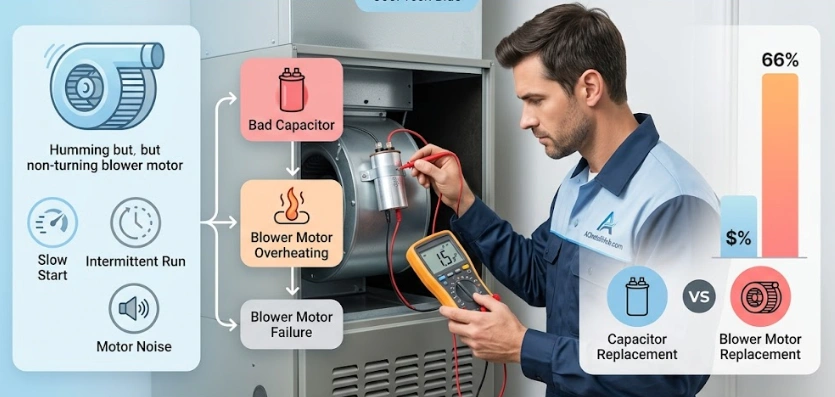
Pull the blower compartment on a furnace that’s been humming for three weeks and you’ll usually find the same thing. A capacitor with a domed top, weeping oil around the terminals. A blower motor that’s been pulling above its rated amp spec since the cap started weakening.
That sequence runs on repeat across service calls in Wayne, Oakland, and Macomb counties. The capacitor is a $15 part. Leave it alone long enough and it takes the blower motor with it — and that repair runs $400 to $1,500.
We’ve seen homeowners write off the hum for weeks, assume the furnace was “settling in,” and wait until the motor seized. Every single time, it was preventable.
Catch it early and you’re out $25 and an hour. Miss it and you’re scheduling a blower motor replacement.
TL;DR Quick Answers
Furnace Capacitor Replacement
A furnace capacitor runs $10 to $25 for the part alone. Add a service call and professional replacement lands between $100 and $300. Wait until the blower motor burns out and you’re looking at $400 to $1,500. The replacement must match the failed unit’s exact µF and voltage rating. A mismatched cap causes premature failure or motor damage. If the blower is humming but won’t start, or your air quality has taken a hit, don’t wait. The part is cheap and the fix is quick. The blower motor is neither.
Top Takeaways
- The furnace capacitor is the most common and least expensive cause of blower motor failure. It’s also the most preventable.
- Bad furnace capacitor symptoms to know: blower humming without starting, short-cycling, no airflow after ignition fires, uneven heat distribution, and a burning smell near the air handler.
- A swollen top or oily residue on the capacitor casing confirms internal failure. Stop running the system. No diagnostic tool required.
- Catch it for $10 to $25, or replace the blower motor for $400 to $1,500. Those are the two outcomes when a capacitor fails unchecked.
- Every central heating furnace depends on a working blower motor to push heated air through the home. The capacitor is what gives that motor its starting charge on every heating cycle.
Table of Contents
What Is a Furnace Capacitor and What Does It Do?
A furnace capacitor is a small, sealed cylindrical component mounted inside the blower compartment. It stores electrical energy and releases it in a controlled burst to start the blower motor, then holds the motor at steady operating speed throughout the heating cycle.
Most systems carry two types. The start capacitor delivers the jolt the motor needs to break inertia and begin spinning. The run capacitor holds voltage while the motor operates. Many modern furnaces combine both into a single dual-run capacitor, which is why HVAC technicians sometimes use “blower motor capacitor” and “furnace capacitor” interchangeably on a service call.
When the capacitor weakens, the blower motor can’t complete startup. Heat builds at the heat exchanger, the safety limit switch trips, and the furnace shuts down. The motor tries again. And again. Until it burns out completely or someone opens the cabinet and finds the cause.
7 Bad Furnace Capacitor Symptoms to Catch Before the Motor Gives Out
Catching furnace capacitor signs early is the difference between a $25 fix and a $1,500 motor replacement. Here’s what shows up consistently on our service calls, in order of frequency:
- Furnace blower won’t start. The thermostat calls, ignition fires, but the blower never engages. You may hear a click, then nothing. The motor gets its signal from the control board but can’t complete the startup sequence without the capacitor’s stored charge.
- Humming with no airflow. The motor is trying. It just can’t break startup inertia without the capacitor’s discharge. This is the most common bad furnace capacitor symptom we see on Metro Detroit calls, and the one homeowners most often mistake for normal furnace noise.
- Short-cycling. The furnace fires, the blower labors to reach operating speed, the heat exchanger overheats, the limit switch trips, and the furnace restarts. That cycle repeats until something gives out for good or a technician shows up.
- Weak or uneven airflow. Capacitor degradation cuts motor RPM before causing full failure. Some rooms warm. Others stay cold. This symptom often runs undiagnosed for weeks while the motor absorbs the strain.
- Humming, clicking, or buzzing at startup. The relay fires but the capacitor can’t close the circuit. That’s the motor working against inertia with too little stored energy to win.
- Swelling or oily residue on the casing. A domed top or dark residue around the terminals means the capacitor has already failed internally. Stop running the system. This one doesn’t need a meter. It needs a replacement.
- Burning smell from the air handler. A failing capacitor forces the motor windings to overheat. That’s a late-stage signal. Shut the system off at the thermostat and the breaker immediately.
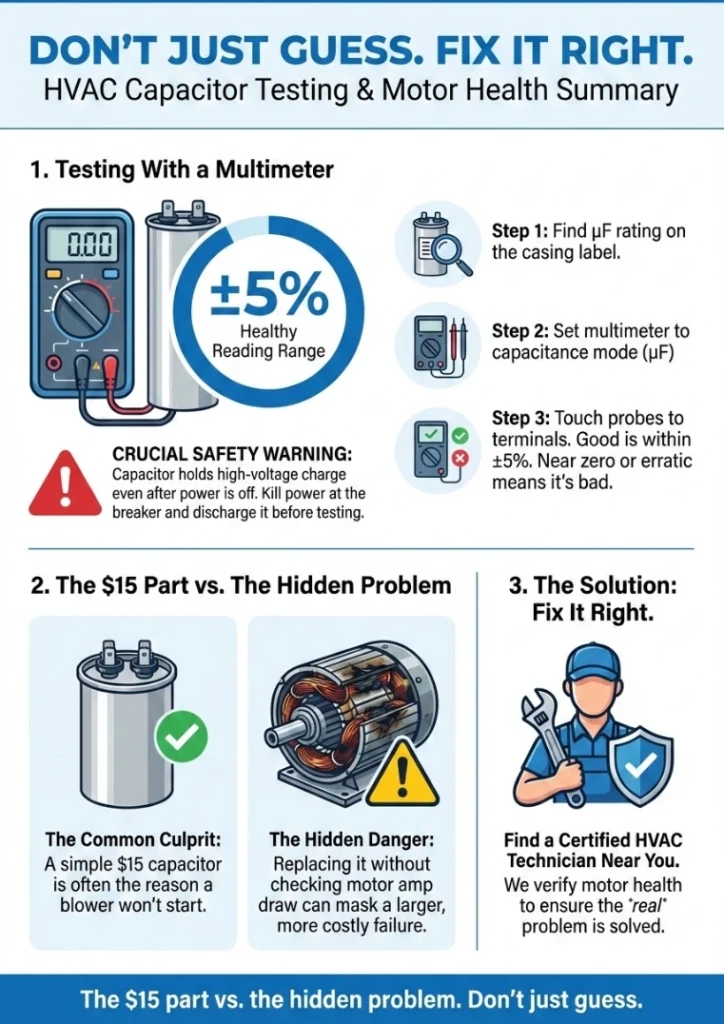
Field note: In roughly 80% of the blower motor capacitor failure calls we’ve run, the capacitor was a symptom, not the root cause. A struggling motor draws excess current, which speeds up capacitor failure. Replacing the cap without checking the motor’s amp draw is how a $300 service call turns into a $1,500 blower motor job three weeks later.
How to Test a Furnace Capacitor: Step by Step
The safety note first: a capacitor holds a high-voltage charge even after the furnace is fully powered off. Discharge it before touching any terminals. If you’re not comfortable around electrical components, skip to the cost section and call a certified tech.
Here’s how to test furnace capacitor health with a multimeter:
- Kill power at the circuit breaker and the furnace disconnect switch.
- Open the blower compartment and locate the capacitor. It’s a cylindrical can with terminals on top.
- Discharge the capacitor by bridging the terminals with an insulated screwdriver.
- Find the µF and voltage rating on the casing label. You’ll need this to match the replacement exactly.
- Set your multimeter to capacitance mode (µF or F).
- Touch the probes to the terminals. A healthy capacitor reads within ±5% of its rated µF. A failed one reads near zero or swings erratically.
- Visual shortcut: a bulging top or oily residue means failure. No meter needed. Replace it.
Not all consumer multimeters include a capacitance mode. When in doubt, start with the visual check. A good capacitor has a flat top. A failed one makes it obvious.
Blower Motor Capacitor Failure: When the Cap Is Just the Start
A new capacitor doesn’t confirm the motor is healthy. If the blower motor’s amp draw still runs above its rated spec after the new cap goes in, the motor is degrading. Another call is coming.
Quick field guide:
- Hum with no start: test and replace the capacitor first.
- Starts but overheats within 20 minutes: check the thermal overload and the capacitor together.
- No response, no hum: likely a control board fault or a shorted run capacitor. Call a certified technician.
We run a clamp meter on every HVAC capacitor replacement job. When the motor’s amp draw sits 10 to 15% above its rated spec after the new cap is in, we flag it before closing the job. Replacing only the capacitor without checking motor health is how a preventable repair becomes an expensive one.
Furnace Capacitor Cost: The Honest Breakdown
What HVAC capacitor replacement actually costs, by scenario:
- Part only (DIY replacement): $10 to $25
- Professional service call with replacement: $100 to $300
- Emergency or after-hours service: add $75 to $150
- Full motor diagnostic: $75 to $150
- Blower motor replacement when capacitor failure goes unaddressed: $400 to $1,500
If your system uses a dual-run capacitor shared between the furnace blower and the AC condenser fan, parts run a bit higher — $15 to $45 — but one replacement covers two components. For homeowners weighing AC capacitor replacement cost alongside furnace repair, knowing the dual-run scenario before the tech arrives saves time on the call.
Labor rates vary by market. System access affects time on the call. The part price holds steady nationwide. If you’re looking for furnace capacitor near me, our network of certified HVAC technicians covers most U.S. metro areas with same-day availability and pricing disclosed before the truck rolls.
“Nine times out of ten, when a homeowner calls about a furnace blower that won’t start, the capacitor is the first thing I check. It’s a $15 part, but only if you catch it before it takes the motor with it.”
7 Essential Resources
Authoritative references for HVAC maintenance standards, furnace safety, and home heating system guidance:
- U.S. Department of Energy — Furnaces and Boilers
- ENERGY STAR — Heating & Cooling Products
- Air Conditioning Contractors of America (ACCA)
- U.S. Consumer Product Safety Commission — Home Heating Safety
- U.S. EPA — Indoor Air Quality & HVAC
- AHRI — Air-Conditioning, Heating, and Refrigeration Institute
- ASHRAE — HVAC Technical Resources & Standards
3 Statistics Worth Knowing
- Heating and cooling account for approximately 43% of a typical U.S. home’s total energy costs, making HVAC maintenance one of the highest-impact decisions a homeowner can make on annual operating expenses. (U.S. Department of Energy)
- About 46% of U.S. households use natural gas as their primary space heating fuel, which means furnace component failures, including blower motor capacitor failure, affect nearly half of American homeowners each heating season. (U.S. Energy Information Administration)
- Heating equipment is involved in roughly 1 in 7 home structure fires reported to U.S. fire departments annually, which shows why addressing furnace electrical component failures like a deteriorating capacitor matters before symptoms become visible. (National Fire Protection Association)
Final Thoughts and Our Take
A failed furnace capacitor doesn’t have to become an emergency. It becomes one when you wait.
On service calls across Metro Detroit, the homeowners who handle HVAC repairs well know what’s actually at stake before they call. A $15 capacitor and a $1,500 blower motor are two completely different problems. The furnace capacitor signs (the hum, the short-cycling, the swollen casing) are what put you in the right conversation.
If you can safely access the blower compartment, the visual check is worth running before any tech arrives. A domed capacitor top is a confirmed failure. You don’t need a meter for that. Knowing it going into a service call changes how that conversation goes.
One thing we see on nearly every maintenance visit: blower motor failures that had been building for months were almost always preceded by a filter nobody had changed. A restricted filter makes the blower work harder. That extra load accelerates capacitor wear. Regular filter changes do more to prevent premature capacitor failure than any preventive part swap. Keep the filter clean, change it on schedule, and the blower never has to strain for airflow in the first place.
Catch the symptoms early. Match the replacement spec exactly. When motor amp draw runs high after the new cap goes in, flag it before the job closes.
Frequently Asked Questions
What are the most common bad furnace capacitor symptoms?
A blower that hums without starting is the call we get most often. Short-cycling comes close behind: the furnace fires, overheats, and resets, repeatedly, until something gives. Beyond those two, look for no airflow after ignition, weak or uneven heat across rooms, and a burning smell from the air handler. Visible indicators include a swollen or domed casing and oily residue around the terminals. Any one of those signs warrants an inspection before the motor takes on more damage.
How do I test a furnace capacitor at home?
Discharge it first. The capacitor holds voltage even with the furnace fully powered off, and that’s not a mistake you make twice. After discharging: set a multimeter to capacitance mode (µF), touch the probes to the terminals, and compare the reading to the rated µF on the casing label. Within ±5% of the rating means the cap is good. Near zero or erratic readings mean it’s not. Fastest check: look at the top of the casing. Flat is healthy. Domed or oily means replace the filter.
How much does furnace capacitor replacement cost?
The part runs $10 to $25. Professional service with replacement costs $100 to $300. Emergency or after-hours calls add $75 to $150. Let the failure go long enough to burn out the blower motor and the repair climbs to $400 to $1,500. The furnace capacitor cost is the floor. Motor replacement is the ceiling. Catching the symptoms early keeps you at the floor.
What is the difference between a start capacitor and a run capacitor?
A start capacitor delivers the energy burst the blower motor needs to break inertia and begin spinning. Once the motor is running, the run capacitor takes over and holds voltage at a steady operating level. Many modern furnaces consolidate both into one dual-run capacitor, which is why technicians on a service call often use the terms interchangeably.
Can a bad capacitor damage the blower motor?
Yes, and this is why deferred action costs so much. A failing capacitor makes the blower motor draw excess current trying to compensate. That current overheats the motor windings over time and burns them out. What starts at $15 ends at $400 to $1,500. Blower motor capacitor failure is not a low-priority symptom.
Why does my furnace blower hum but not start?
That hum is the motor trying to start without enough stored energy from the capacitor to complete the sequence. It’s the most common furnace capacitor sign we diagnose on field calls. A capacitor replacement resolves it in most cases, but a full motor diagnostic is still the right call before closing the job. The hum might mean the motor has been pulling above spec long enough to have its own problems.
What does a failed furnace capacitor look like?
The top is domed instead of flat. Dark oily residue often collects around the terminals or along the casing. Both are internal failure indicators that don’t need a multimeter to confirm. If you see either one, stop running the system and replace the capacitor.
How does AC capacitor replacement cost compare to furnace capacitor cost?
Part costs run in the same range: $10 to $45, depending on whether the system uses a standard or dual-run capacitor. If the HVAC system shares a dual-run capacitor between the furnace blower and the AC condenser fan, one replacement covers both components. AC capacitor replacement cost at the professional service level runs $100 to $300, the same range as furnace capacitor replacement.
How do I find furnace capacitor replacement near me?
ACInstallHub connects homeowners with certified, vetted HVAC technicians across the country. The right tech replaces the part and confirms the motor is healthy, not just swaps the cap and leaves. Our network offers same-day availability with pricing disclosed before anyone touches the system. That’s what to look for when searching furnace capacitor near me.
Ready to Test or Replace a Bad Furnace Capacitor? Connect with a Certified HVAC Tech Today.
If the furnace blower won’t start, you’ve spotted signs of blower motor capacitor failure, or you want a professional to confirm what you’re hearing, ACInstallHub connects you with certified local technicians who diagnose, test, and replace furnace capacitors with same-day availability and transparent pricing. You know the full cost before anyone touches the system.
Find a Certified HVAC Technician Near You